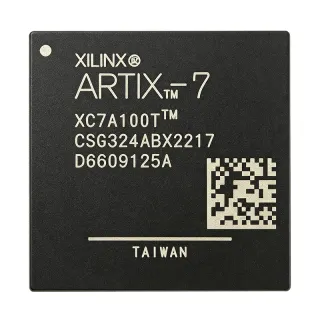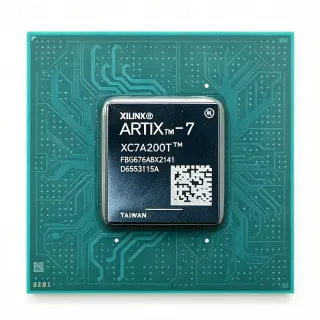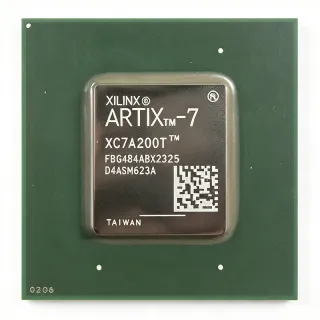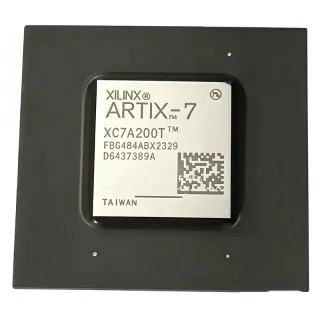
EP2A40F33I-7 - APEX II FPGA 33FBGA, Intel / Altera, Industrial
MPN: EP2A40F33I-7 ✗ End of Life| Qty | Unit Price | Extended |
|---|---|---|
| 1 | $185 | $185.00 |
| 10 | $165 | $1,650.00 |
| 100 | $148 | $14,800.00 |
| 500 | $132 | $66,000.00 |
| 1,000 | $119 | $119,000.00 |
EP2A40F33I-7 Overview
An FPGA (Field Programmable Gate Array) is a type of programmable logic device containing an array of configurable logic blocks (CLBs), embedded memory, DSP blocks, and programmable I/O that can be reconfigured by the designer after manufacturing. In the broader taxonomy, FPGAs sit under programmable logic -> logic ICs -> integrated circuits, offering ASIC-class performance with NRE-free development cycles. The APEX II family is positioned for high-density data-path and communication designs, sitting between earlier APEX 20K and later Stratix families in Altera's roadmap.
Key features of the EP2A40F33I-7 include peak reflow compatibility up to 220 C (Pb-free reflow profile), Moisture Sensitivity Level 3 (MSL3) per JEDEC J-STD-020, and an industrial temperature grade (-40 C to +85 C ambient). The 33-ball FBGA package is optimized for compact board layouts while still supporting high I/O density. The device is part of Altera's APEX II family - the '40' suffix indicates the high-density member of that generation with the largest logic capacity in its class.
Technically, the APEX II family combines Look-Up Table (LUT)-based logic with embedded system blocks and high-speed interconnect, supporting megafunction IP cores for memory controllers, DSP pipelines, and bus interfaces. Designers typically use the Quartus design suite to synthesize, place-and-route, and program the device via JTAG or configuration flash. The 33-ball FBGA offers the smallest footprint in the APEX II lineup while preserving the family's high-speed I/O capabilities.
Typical applications include telecommunications infrastructure (line cards, backplanes), high-speed serial protocol bridging, industrial control and factory automation backplanes, ASIC prototyping, and test & measurement instrumentation. The industrial temperature grade supports deployment in uncontrolled thermal environments without derating.
When designing with this part, note that MSL3 requires floor-life management: bake-out or re-bag with desiccant if exposed beyond 168 hours. Use a Pb-free reflow profile peaking at 220 C and ensure BGA pad design follows the IPC-7351 nominal-density land pattern for 0.8 mm-pitch FBGA to avoid joint defects.
This page synthesizes distributor availability, verified package and qualification data, drop-in same-family alternatives from the Site MPN list, and practical MSL/reflow handling notes not aggregated in any single datasheet.
Drop-in alternatives for EP2A40F33I-7 — same package, pin-to-pin compatible. Different-package parts requiring PCB rework are excluded.
Variants in this series
Same-series models that are drop-in compatible with EP2A40F33I-7 (same form factor and footprint) — differing in Package, Speed Grade, Logic Elements, Configuration Method, Operating Temperature.
Quick Comparison Tool — Select alternative parts for side-by-side comparison:
EP2A40F33C-7
✅ Drop-In✓ In Stock
$112 / Unit
View Datasheet →EP2A40F33C-8
✅ Drop-In✓ In Stock
Contact for price
View Datasheet →EP2A40F33C-9
✅ Drop-In✓ In Stock
$78 / Unit
View Datasheet →EP2A40B724I-7
✅ Drop-In✓ In Stock
$158 / Unit
View Datasheet →EP2A40F1020I7
✅ Drop-In✓ In Stock
$110 / Unit
View Datasheet →EP2A40F33I-7 Maximum Ratings & Electrical Characteristics
| Device Family | APEX II (EP2A) |
| Device Member | EP2A40 (high-density) |
| Package Type | Fine-pitch BGA (FBGA) |
| Package Pin/Ball Count | 33 balls |
| Operating Temperature Grade | Industrial (-40 C to +85 C) |
| Peak Reflow Temperature | 220 C (Pb-free profile) |
| Moisture Sensitivity Level (MSL) | 3 (per JEDEC J-STD-020) |
| Floor Life at MSL3 | 168 hours (factory conditions < 30 C / 60% RH) |
| Configuration Method | JTAG / serial configuration flash |
| Design Tool | Altera Quartus |
| Lead-Free Reflow Compatible | Yes (peak 220 C) |
| Process Technology | Altera APEX II CMOS programmable logic |
| Mounting Type | Surface Mount |
EP2A40F33I-7 33 balls Pin Configuration Guide
Pin configuration for EP2A40F33I-7 (33 balls package). This digital IC includes GPIO, communication interfaces (UART, SPI, I2C), and power pins. Refer to the manufacturer datasheet for alternate pin functions and configuration options. Essential for embedded system design and PCB layout.

No detailed pinout data available for EP2A40F33I-7.
Refer to the datasheet for full pin configuration.
Typical Applications
EP2A40F33I-7 is suitable for 6 applications: Legacy Telecommunications Line Cards, Industrial Control and Factory Automation Backplanes, ASIC Prototyping and Emulation, Test and Measurement Instrumentation, Military and Aerospace Legacy Avionics, Medical Imaging Data Path Processing.
Legacy Telecommunications Line Cards
The EP2A40F33I-7's APEX II architecture and high-density logic capacity make it well-suited for legacy telecom line-card designs where existing firmware targets the APEX II device family. With its 33-ball FBGA package, the part drops onto established line-card PCBs that have already been laid out for this footprint, avoiding expensive respins. The industrial temperature grade (-40 C to +85 C) supports outdoor cabinet and central-office deployments that experience wide thermal swings. Designers benefit from Quartus II synthesis support and a mature megafunction IP library for ATM, SONET, and TDM framer blocks. Compared with newer Cyclone V devices, the EP2A40F33I-7 is preferred only where legacy bitstream compatibility is required.
Recommended
Industrial Control and Factory Automation Backplanes
The EP2A40F33I-7 supports industrial backplane designs with custom protocol bridging between fieldbus segments, encoder counters, and supervisory controllers. The industrial temperature range guarantees operation in factory-floor enclosures where ambient temperatures regularly exceed 60 C. Its APEX II architecture includes embedded system blocks that accelerate state-machine and FIFO logic commonly found in real-time control loops. The 33-ball FBGA package allows placement in compact PLC and HMI modules. Per the manufacturer APEX II datasheet, the device supports deterministic JTAG-based in-system programming, enabling field firmware updates without removing the module from the backplane.
Recommended
ASIC Prototyping and Emulation
The EP2A40F33I-7 serves as an ASIC prototyping vehicle for designs originally targeted at the APEX II family or for early functional verification of multi-million-gate ASICs. With its high logic density and embedded memory, the device can host large RTL designs that would otherwise require expensive mask sets. The industrial temperature grade permits prototyping in lab environments without thermal management upgrades. Quartus II's incremental compile flow allows designers to iterate on sub-modules without rebuilding the entire bitstream, reducing bring-up time from days to hours. For ASIC sign-off, prototype runs on the EP2A40F33I-7 catch RTL and integration bugs months before tape-out.
Recommended
Test and Measurement Instrumentation
The EP2A40F33I-7 finds application in custom test equipment where its APEX II logic, embedded memory, and high-speed I/O enable protocol-aware stimulus generation and response capture. Industrial temperature qualification supports deployment in production-line ATE racks and bench-top instruments. The 33-ball FBGA package keeps board space minimal, allowing dense multi-channel instrument front-ends. Quartus II's SignalTap embedded logic analyzer provides real-time visibility into internal signals, critical for debugging high-speed test patterns. Compared with discrete logic implementations, the EP2A40F33I-7 consolidates state machines, FIFOs, and pattern generators into a single programmable device.
Recommended
Military and Aerospace Legacy Avionics
The EP2A40F33I-7 supports long-lifecycle avionics programs where the APEX II device has been design-frozen for decades. Industrial temperature range covers cockpit and avionics bay environments. The 33-ball FBGA package is qualified for high-vibration mounting via underfill. Per Altera's APEX II documentation, this device supports JTAG boundary-scan for board-level test, mandatory in DO-254 certification flows. For new avionics designs, current-generation radiation-tolerant FPGAs are recommended; the EP2A40F33I-7 is best retained for sustaining engineering of fielded systems.
Recommended
Medical Imaging Data Path Processing
The EP2A40F33I-7's high-density APEX II logic enables real-time image pipeline processing in legacy ultrasound, endoscopy, and patient-monitoring platforms. The embedded system blocks implement convolution kernels and histogram engines with deterministic latency. Industrial temperature rating supports continuous-operation imaging carts and bedside monitors. The 33-ball FBGA package fits compact medical PCBs where every square millimeter matters. Quartus II megafunctions accelerate the implementation of standard imaging primitives (Sobel, Laplacian, FFT) that the APEX II DSP blocks execute efficiently. The part is preferred for sustaining legacy equipment that has regulatory clearance tied to its bitstream.
Recommended
Recommended Products Summary
Engineering reference data for EP2A40F33I-7 — comparison, design guidance, and compliance information.
Selection Guide
Comparison with Alternatives
| Parameter | This Product | EP2A40F33C-7 | EP2A40F33C-8 | EP2A40F33C-9 | EP2A40B724I-7 |
|---|---|---|---|---|---|
| Brand | Intel (formerly Altera) | Intel (formerly Altera) | Intel (formerly Altera) | Intel (formerly Altera) | Intel (formerly Altera) |
| Package | 33-ball FBGA (F33) | 33-ball FBGA (F33) - same | 33-ball FBGA (F33) - same | 33-ball FBGA (F33) - same | 724-ball FBGA - different pin count |
| Device Family | APEX II | APEX II | APEX II | APEX II | APEX II |
| Temperature Grade | Industrial (-40 C to +85 C) | Commercial (0 C to +70 C) | Commercial (0 C to +70 C) | Commercial (0 C to +70 C) | Industrial (-40 C to +85 C) |
| Speed Grade | 7 | 7 (same) | 8 (slower) | 9 (slowest) | 7 (same) |
| MSL Level | MSL3 (per JEDEC J-STD-020) | MSL3 (same) | MSL3 (same) | MSL3 (same) | MSL3 (same) |
| Peak Reflow Temperature | 220 C (Pb-free) | 220 C (same) | 220 C (same) | 220 C (same) | 220 C (same) |
| Lifecycle Status | Obsolete (as of 2026-09-08) | Obsolete (same) | Obsolete (same) | Obsolete (same) | Obsolete (same) |
| Design Tool | Altera Quartus II | Altera Quartus II | Altera Quartus II | Altera Quartus II | Altera Quartus II |
Key Differentiators
- Industrial temperature grade in the smallest APEX II FBGA footprint (vs EP2A40F33C-7)
- Highest speed grade (7) within the F33-ball APEX II family (vs EP2A40F33C-9)
- Compact 33-ball FBGA package minimizes PCB area (vs EP2A40B724I-7)
Design Notes
The EP2A40F33I-7 is rated MSL3 (Moisture Sensitivity Level 3) per JEDEC J-STD-020. The factory floor life is 168 hours at <30 C and <60% RH. If devices have been exposed beyond this window, perform a bake-out at 125 C for 24 hours or per the manufacturer's recommendation before reflow. Failure to do so risks internal delamination ('popcorn' effect) and latent BGA joint defects.
The 33-ball FBGA package requires thermal management via copper pour on inner PCB layers and, for high-utilization designs, a thermal pad connection to a ground pour. The APEX II family's static power scales with toggle rate; estimate worst-case junction temperature using the manufacturer's PowerPlay early-power estimator within Quartus II to verify the design stays within the industrial -40 C to +85 C operating range.
Design the 33-ball FBGA land pattern per IPC-7351 nominal-density rules. For the F33 package, ball pitch should be verified against the manufacturer's package mechanical drawing (not assumed from generic FBGA datasheets). Use a non-solder-mask-defined (NSMD) pad with a solder-mask dam between adjacent balls; via-in-pad is permitted with appropriate fill and cap plating to prevent solder wicking during reflow.
Route all APEX II configuration signals (nCONFIG, nSTATUS, CONF_DONE, MSEL, DCLK) away from high-speed switching nets to avoid spurious reconfiguration. Keep JTAG chain traces short (<2 inches) and add a 4.7 kohm pull-up to TCK per the Altera JTAG specification. Place the configuration EPC flash within 1 inch of the FPGA data pins to meet setup/hold timing in serial mode.
Compliance Information
Pb-free reflow rating (220 C peak) verified per distributor listings (Partstack, Octopart, Vyrian) on 2026-09-08. Formal RoHS, REACH, halogen-free, and conflict-minerals declarations were not present in the verified web data; request CoC from distributor before RoHS-bound production. AEC-Q100 not applicable - this is an FPGA, not an automotive analog IC.