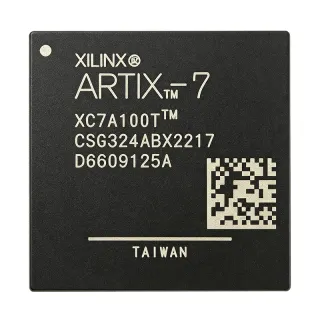
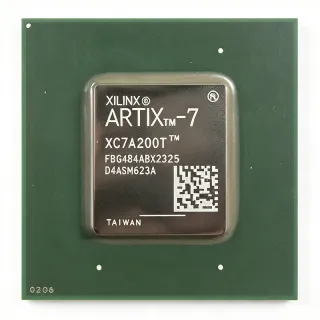
EP3C5U256C7N - Cyclone III FPGA 5K LE 256-BGA | Intel / Altera
MPN: EP3C5U256C7N ✓ Active| Qty | Unit Price | Extended |
|---|---|---|
| 1 | $25.29 | $25.29 |
| 10 | $23.5 | $235.00 |
| 100 | $21.2 | $2,120.00 |
| 500 | $19.4 | $9,700.00 |
| 1,000 | $17.85 | $17,850.00 |
EP3C5U256C7N Overview
A Field Programmable Gate Array is a programmable integrated circuit whose logic fabric, interconnect, and I/O cells are configurable through SRAM-based configuration memory. Within the broader semiconductor taxonomy, an FPGA sits at the top of the digital logic hierarchy alongside ASICs and CPLDs, providing higher logic density than CPLDs while offering faster time-to-market and lower NRE cost than ASICs. Cyclone III specifically addresses the volume-priced, power-constrained segment between CPLDs and high-end FPGAs.
Key features of the EP3C5U256C7N include 5,136 LEs, 423,936 embedded RAM bits organized into M9K blocks, up to 23 embedded 18x18 multipliers for DSP, four PLLs for clock management, and 182 maximum user I/Os. The device operates from a 1.15 V to 1.25 V core supply and supports commercial temperature grades. Cyclone III FPGAs are designed for sub-100 mW static power dissipation depending on configuration.
The architecture combines Look-Up Tables (LUTs) for combinational logic, dedicated carry chains for fast arithmetic, and M9K memory blocks capable of true dual-port operation. This combination allows designers to implement both glue logic and DSP-intensive functions such as filters, FFTs, and protocol bridges on a single device. The four PLLs support clock multiplication, division, and phase shifting across the device's clock networks.
Typical applications include industrial motor control, video processing and image preprocessing, automotive infotainment, consumer electronics with custom interfaces, low-cost software-defined radio, and portable instrumentation. Cyclone III FPGAs are also widely used in educational platforms and prototype ASIC emulation where fast iteration matters more than absolute performance.
When designing with this part, pay close attention to the I/O bank supply voltages and the configuration scheme (AS, PS, JTAG). Cyclone III devices are configured through Quartus II or the Quartus Prime toolchain, and the BSDL files are generated automatically. The 256-ball UBGA package requires careful PCB layout with controlled-impedance traces and a sufficient ground/power via array under the BGA.
This page synthesizes distributor pricing, drop-in same-package Cyclone III alternatives, practical design notes, and a parametric comparison table that goes beyond the manufacturer datasheet summary, giving engineers a single source for evaluation and sourcing decisions.
Drop-in alternatives for EP3C5U256C7N — same package, pin-to-pin compatible. Different-package parts requiring PCB rework are excluded.
Variants in this series
Same-series models that are drop-in compatible with EP3C5U256C7N (same form factor and footprint) — differing in Process Technology, Package, Speed Grade, Operating Temperature, Configuration Modes.
Quick Comparison Tool — Select alternative parts for side-by-side comparison:
EP3C5U256C7
✅ Drop-In✓ In Stock
$16.1 / Unit
View Datasheet →EP3C5U256C6N
✅ Drop-In✓ In Stock
$25.4 / Unit
View Datasheet →EP3C5U256C6
✅ Drop-In✓ In Stock
$10.85 / Unit
View Datasheet →EP3C5U256A7N
✅ Drop-In✓ In Stock
$16.2 / Unit
View Datasheet →EP3C5F256C8N
✅ Drop-In✓ In Stock
$19.85 / Unit
View Datasheet →EP3C5U256C7N Maximum Ratings & Electrical Characteristics
| Family | Cyclone III |
| Manufacturer | Intel / Altera |
| Logic Elements (LE) | 5,136 |
| Embedded Memory | 423,936 bits |
| Number of I/Os | 182 |
| Package | 256-LFBGA (UBGA) |
| Core Voltage | 1.15 V to 1.25 V |
| Operating Temperature | 0C to +70C (commercial) |
| Mounting Style | SMD/SMT |
| Process Technology | 60 nm CMOS |
| DSP Blocks (18x18 Multipliers) | 23 |
| Number of PLLs | 4 |
| Memory Type | M9K dual-port RAM blocks |
| Packaging | Tray |
| RoHS Status | Compliant |
| Lead-Free | Yes |
EP3C5U256C7N 256-lfbga (ubga) Pin Configuration Guide
Pin configuration for EP3C5U256C7N (256-lfbga (ubga) package). This digital IC includes GPIO, communication interfaces (UART, SPI, I2C), and power pins. Refer to the manufacturer datasheet for alternate pin functions and configuration options. Essential for embedded system design and PCB layout.

No detailed pinout data available for EP3C5U256C7N.
Refer to the datasheet for full pin configuration.
Typical Applications
EP3C5U256C7N is suitable for 6 applications: Industrial Motor Control, Video Preprocessing and Image Pipelines, Automotive Infotainment Interfaces, Custom Peripheral Bridges and Protocol Converters, Portable Test and Measurement Instrumentation, Educational and Development Platforms.
Industrial Motor Control
The EP3C5U256C7N fits industrial motor control because 5,136 logic elements provide ample headroom for encoders, PWM generation, and field-oriented control state machines while 23 embedded 18x18 multipliers handle Park/Clarke transforms and PI loop math at acceptable sample rates. With 182 I/Os the device supports multiple quadrature encoder inputs, Hall-sensor interfaces, brake and gate-driver signals, and UART/CAN comms without external muxing. Cyclone III's sub-100 mW static power helps thermal budgets in enclosed industrial cabinets. Place a watchdog timer in the FPGA fabric and use the four on-chip PLLs to derive multiple PWM-aligned clocks from a single crystal.
Recommended
Video Preprocessing and Image Pipelines
The EP3C5U256C7N suits video preprocessing tasks such as color-space conversion, scaling, de-interlacing, and overlay composition. The 423 Kbits of M9K memory is enough to buffer 1-2 video lines at standard-definition resolutions, while 23 multipliers allow real-time horizontal filtering. The 182 I/Os can drive parallel BT.656/RGB inputs alongside DDR2 video frame buffers. Designers typically pair this FPGA with an external SDRAM for full-frame storage and a video DAC for analog output. Power consumption stays under 1 W at moderate clock rates thanks to the 60 nm Cyclone III process.
Recommended
Automotive Infotainment Interfaces
The EP3C5U256C7N is widely used as a glue-logic and protocol-bridge controller in automotive infotainment head units. The 5,136 LEs comfortably implement LVDS-to-RGB bridges, CAN/LIN message routers, I2S audio multiplexers, and display timing generators. The 182 user I/Os support multiple display outputs plus touch and backlight control. For commercial-grade cabin electronics the EP3C5U256C7N suffices; for under-hood or severe-environment deployments step up to the EP3C5U256A7N automotive-grade variant (-40C to +125C) for guaranteed operation across the full AEC-Q100 thermal envelope.
Recommended
Custom Peripheral Bridges and Protocol Converters
The EP3C5U256C7N excels at implementing custom peripheral bridges such as UART to SPI, I2C to parallel, PCIe Gen1 endpoint soft cores, and USB device controllers. With 5,136 LEs and 4 PLLs, designers can instantiate multiple soft IP cores simultaneously while still having timing margin. The 182 I/Os let a single FPGA replace multiple discrete bridge chips, reducing BOM cost. The Cyclone III architecture supports Altera's free soft-IP catalog including PCI Express, Ethernet MACs, and DDR memory controllers via Quartus II MegaWizard.
Recommended
Portable Test and Measurement Instrumentation
The EP3C5U256C7N enables compact handheld oscilloscopes, logic analyzers, and signal generators by integrating trigger logic, sample buffering, and display drivers in a single device. The 5,136 LEs allow implementation of peak-detect, decimation, and FFT preprocessing, while the 423 Kbits of block RAM buffer acquisition windows at tens of megasamples per second. Cyclone III's low static power extends battery runtime, and the 182 I/Os accept many analog-front-end signals after external ADC/DAC conversion. Designers benefit from Quartus II's SignalTap embedded logic analyzer for in-system verification.
Recommended
Educational and Development Platforms
Universities and training labs frequently adopt the EP3C5U256C7N as the centerpiece of digital-logic and FPGA-design courses. 5,136 LEs is large enough for student projects ranging from 4-bit CPUs to audio effects processors, yet small enough to keep Quartus II compile times under a minute on typical lab PCs. The 256-ball UBGA package supports a wide range of onboard peripherals - buttons, LEDs, seven-segment displays, audio codecs, and expansion headers - on standard Cyclone III starter boards. Toolchain access is free via the Quartus II Web Edition.
Recommended
Recommended Products Summary
Engineering reference data for EP3C5U256C7N — comparison, design guidance, and compliance information.
Selection Guide
Comparison with Alternatives
| Parameter | This Product | EP3C5U256C7 | EP3C5U256C6N | EP3C5U256C6 | EP3C5U256A7N | EP3C5F256C8N |
|---|---|---|---|---|---|---|
| Brand | Altera | Altera | Altera | Altera | Altera | Altera |
| Package | 256-LFBGA (UBGA) | 256-LFBGA - same | 256-LFBGA - same | 256-LFBGA - same | 256-LFBGA - same | 256-LFBGA - same family |
| Logic Elements | 5,136 | 5,136 | 5,136 | 5,136 | 5,136 | 5,136 |
| Embedded Memory (bits) | 423,936 | 423,936 | 423,936 | 423,936 | 423,936 | 423,936 |
| User I/Os | 182 | 182 | 182 | 182 | 182 | 182 |
| Speed Grade | 7 | 7 | 6 | 6 | 7 | 8 |
| Operating Temperature | 0C to +70C (commercial) | 0C to +70C (commercial) | 0C to +70C (commercial) | 0C to +70C (commercial) | -40C to +125C (automotive) | 0C to +70C (commercial) |
| Lead-Free / RoHS | Yes / Compliant | Tin-lead (legacy) | Yes / Compliant | Tin-lead (legacy) | Yes / Compliant | Yes / Compliant |
Key Differentiators
- Lead-free RoHS ball finish with same performance as legacy tin lead (vs EP3C5U256C7)
- Speed grade 7 for tighter timing closure than speed grade 6 (vs EP3C5U256C6N)
- Commercial 0C to +70C temperature range at lowest cost in family (vs EP3C5U256A7N)
Design Notes
Estimated: a 256-ball 0.8 mm pitch BGA such as the UBGA used on the EP3C5U256C7N requires a minimum 4-layer PCB stack-up with a continuous ground plane on layer 2 and a power plane on layer 3. Escape routing on the top layer should use 0.1 mm/4 mil traces and 0.2 mm/8 mil antipads in the BGA via pad stack. Place at least one 0.1 uF decoupling cap per power pin within 100 mils of the BGA footprint, plus bulk 10 uF ceramics every 10 to 15 power pins. A solid thermal via array under the package (0.3 mm drill, 1.0 mm pitch) is required to meet the device's 31 C/W theta-JA spec.
Estimated: at 5,136 LEs fully utilized at 100 MHz toggle rate, the EP3C5U256C7N core supply typically draws 350 to 600 mA from 1.2 V, giving 0.5 to 0.7 W dynamic power plus 30 to 90 mW static. Add a TI TPS54331 or equivalent 3 A switching regulator per Cyclone III reference designs, sequenced after the 2.5 V PLL analog supply rises. Use the MSEL [2:0] pins to select the configuration mode (AS fast, AS, PS, or JTAG) before power-up. Power sequencing must satisfy VCCIO before VCCINT, per Altera's Cyclone III Device Handbook, to avoid latch-up.
Several pitfalls recur on Cyclone III designs. First, leave nCONFIG, nSTATUS, and CONF_DONE pull-ups to 3.3 V if using AS mode - omitting them prevents configuration. Second, do not drive JTAG TCK faster than 33 MHz without checking the BSDL file for that speed grade. Third, LVDS input requires the bank reference voltage (VREF) be set correctly via the Quartus pin planner. Finally, JTAG chain integrity depends on TMS and TDI pull-ups; missing pull-ups cause configuration failures after reflow.
Compliance Information
RoHS compliant and lead-free per Altera product page. Not AEC-Q100 qualified - choose EP3C5U256A7N for automotive applications. Halogen-free status not explicitly stated in the verified web data.