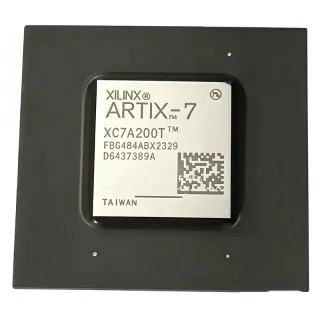
EP4CE55F23C7N - Cyclone IV E FPGA 55K LE 484-FBGA | Intel
MPN: EP4CE55F23C7N ✓ Active| Qty | Unit Price | Extended |
|---|---|---|
| 1 | $78.5 | $78.50 |
| 10 | $72.1 | $721.00 |
| 100 | $64.85 | $6,485.00 |
| 250 | $60.2 | $15,050.00 |
| 500 | $56.4 | $28,200.00 |
EP4CE55F23C7N Overview
A Field Programmable Gate Array (FPGA) is a semiconductor device built around an array of configurable logic blocks (CLBs) connected by programmable interconnect, allowing the hardware function to be defined after manufacture using a hardware description language (HDL). Within the broader semiconductor taxonomy, an FPGA is a programmable logic device that sits between application-specific integrated circuits (ASICs) and general-purpose processors, combining parallel hardware performance with software-like design flexibility.
Key features of the EP4CE55F23C7N include 324 maximum user I/O pins, 4 PLLs, 66 embedded 18x18 multipliers, 56 global clock networks, and up to 472.5 MHz internal clock performance in the C7 speed grade. The device supports high-speed external memory interfaces including DDR2 SDRAM and QDRII+ SRAM, and offers configuration via JTAG, Active Serial (AS), or Passive Serial (PS) modes. Compared with the higher-cost Cyclone V family, Cyclone IV E remains a preferred choice for cost-sensitive, high-volume, low-power designs.
The Cyclone IV E architecture combines a low-leakage process with Cyclone series architectural advances such as multiplier blocks, M9K memory blocks, and a rich set of high-speed I/O standards (LVDS, SSTL, HSTL). This balance of logic density, memory bandwidth, and DSP capability makes the EP4CE55F23C7N suitable for protocol bridging, motor control, video processing, and industrial I/O expansion.
Typical applications include industrial machine vision, motor and motion control, video format conversion, software-defined radio front-ends, LED video walls, and embedded PCIe-over-GPIO bridges. Designers frequently use the EP4CE55F23C7N as a glue-logic and DSP coprocessor alongside ARM Cortex-M or Cortex-A host processors.
When designing with this device, allocate at least four PCB layers for power/ground integrity and route all VCCINT/VCCIO decoupling close to each ball. Confirm Quartus II version compatibility before board bring-up. This page synthesizes distributor pricing, drop-in alternatives, and practical design notes not found in the manufacturer datasheet.
Drop-in alternatives for EP4CE55F23C7N — same package, pin-to-pin compatible. Different-package parts requiring PCB rework are excluded.
Variants in this series
Same-series models that are drop-in compatible with EP4CE55F23C7N (same form factor and footprint) — differing in Package, Speed Grade, Operating Temperature, Embedded 18x18 Multipliers, RoHS Status.
Quick Comparison Tool — Select alternative parts for side-by-side comparison:
EP4CE55F23C6N
✅ Drop-In✓ In Stock
$54.92 / Unit
View Datasheet →EP4CE55F23C8N
✅ Drop-In✓ In Stock
$74 / Unit
View Datasheet →EP4CE55F23I7N
✅ Drop-In✓ In Stock
$119.6 / Unit
View Datasheet →EP4CE55F23A7N
✅ Drop-In✓ In Stock
$134.4 / Unit
View Datasheet →EP4CE55F23C7
✅ Drop-In✓ In Stock
$142 / Unit
View Datasheet →EP4CE40F23C7N
✅ Drop-In✓ In Stock
$21.8 / Unit
View Datasheet →EP4CE55F23C7N Maximum Ratings & Electrical Characteristics
| Family | Cyclone IV E |
| Logic Elements | 55,856 |
| Configurable Logic Blocks (CLBs) | 3,491 |
| Embedded Memory | 2,396,160 bits |
| Maximum User I/O | 324 |
| Embedded 18x18 Multipliers | 66 |
| PLLs | 4 |
| Global Clock Networks | 16 |
| Maximum Operating Frequency | 472.5 MHz (C7 speed grade) |
| Core Voltage (VCCINT) | 1.2 V |
| Process Technology | 60 nm low-power CMOS |
| Package | 484-FBGA (F23) 23 x 23 mm, 1.0 mm pitch |
| Operating Temperature | 0C to +85C (commercial, C7) |
| Configuration Modes | JTAG, Active Serial (AS), Passive Serial (PS) |
| Mounting Type | Surface Mount (BGA) |
| RoHS Status | Compliant |
EP4CE55F23C7N 484-fbga (f23) 23 x 23 mm, 1.0 mm pitch Pin Configuration Guide
Pin configuration for EP4CE55F23C7N (484-fbga (f23) 23 x 23 mm, 1.0 mm pitch package). This digital IC includes GPIO, communication interfaces (UART, SPI, I2C), and power pins. Refer to the manufacturer datasheet for alternate pin functions and configuration options. Essential for embedded system design and PCB layout.

No detailed pinout data available for EP4CE55F23C7N.
Refer to the datasheet for full pin configuration.
Typical Applications
EP4CE55F23C7N is suitable for 6 applications: Industrial Motor Control, Video Processing and Display Bridging, Industrial Machine Vision, Communications Protocol Bridging, Software-Defined Radio Front-End, LED Video Wall Display Controllers.
Industrial Motor Control
The EP4CE55F23C7N is widely used in field-oriented control (FOC) and direct torque control (DTC) motor drives for AC induction, PMSM, and BLDC motors. The 66 embedded 18x18 multipliers execute Park/Clarke transforms and space-vector PWM generation well within the 100 kHz control loop budget. Its 324 user I/Os interface directly to resolver-to-digital converters, incremental encoders, and three-phase gate drivers. The 1.2 V VCCINT core plus 3.3 V VCCIO bank support both modern MCU peripherals and legacy 5 V gate drivers via level shifting. Compared with discrete DSP implementations, the Cyclone IV E device consolidates the control law, commutation logic, and safety interlocks into one programmable device, reducing BOM cost and PCB area in industrial inverter designs.
Recommended
Video Processing and Display Bridging
The EP4CE55F23C7N handles real-time video format conversion (BT.656, BT.1120, HDMI, DisplayPort), chroma upscaling, and OSD overlay in mid-tier broadcast and digital signage equipment. Its 2,396,160 bits of embedded memory provide line buffers for 1080p60 video processing without external SRAM. The 472.5 MHz C7 internal clock supports pixel-clock deinterlacing up to 165 MHz. With 324 user I/Os, the device can drive parallel RGB, LVDS, and mini-LVDS display interfaces simultaneously. Compared with ASSP video processors, the FPGA offers reconfigurable pipeline depth for evolving codec and timing requirements.
Recommended
Industrial Machine Vision
The EP4CE55F23C7N implements real-time image preprocessing pipelines for automated optical inspection (AOI), pick-and-place vision, and barcode/OCR systems. Embedded multipliers accelerate convolution kernels (Sobel, Gaussian, Laplacian) at 60 fps for 1 MPixel sensors. The 3,491 CLBs and 2.4 Mbit memory fit Bayer demosaicing and histogram equalization without external buffers. M9K memory blocks serve as line-scan FIFOs between Camera Link receivers and GigE Vision uplink ASICs. The commercial 0C to +85C grade suits factory-floor enclosures; for outdoor installations migrate to the I7 industrial-temp variant of the same F23 footprint.
Recommended
Communications Protocol Bridging
The EP4CE55F23C7N serves as a multi-protocol bridge in telecom and industrial networking gear, translating between UART, SPI, I2C, CAN, Ethernet, PCIe Gen1, and proprietary backplanes. Its 4 PLLs generate independent clock domains for each protocol island. Up to 472.5 MHz C7 internal clock supports 100 Mbit Ethernet MAC and 100 MHz PCIe endpoint operation. With 324 user I/Os, multiple PHY interfaces can be glued into a single FPGA, eliminating discrete protocol converters. The JTAG and AS configuration modes support in-field firmware updates via the host MCU, ideal for remote site upgrades.
Recommended
Software-Defined Radio Front-End
The EP4CE55F23C7N performs DDC/DUC, channelization, and pulse shaping in cost-sensitive software-defined radio platforms for public safety, land-mobile radio, and low-bandwidth satellite receivers. Its 66 embedded 18x18 multipliers implement 64-tap FIR filters at IF sample rates up to 100 MSPS, while M9K memory blocks hold 1024-tap window buffers. The 4 PLLs derive ADC sample clocks and DAC interpolation clocks from a single reference oscillator. Compared with DSP-only solutions, the parallel architecture reduces latency from millisecond to microsecond, enabling real-time spectrum sensing. The F23 484-BGA package keeps PCB area small for handheld radio designs.
Recommended
LED Video Wall Display Controllers
The EP4CE55F23C7N drives large LED video walls with pixel pitches from 1.5 mm to 10 mm in retail, stadium, and control-room signage. Its 324 user I/Os support 32 parallel HUB75 chains or 16 TTL/LVDS pairs for high refresh rates above 3840 Hz, critical for broadcast camera compatibility. The 2.4 Mbit embedded memory provides scan-line buffers, eliminating external SRAM. The C7 speed grade supports pixel-clock scaling up to 250 MHz for 8K input fan-out. Designers cascade multiple EP4CE55F23C7N devices for video walls exceeding 4K resolution, with each device handling one quadrant. The commercial-temp grade suits indoor installations.
Recommended
Recommended Products Summary
Engineering reference data for EP4CE55F23C7N — comparison, design guidance, and compliance information.
Selection Guide
Comparison with Alternatives
| Parameter | This Product | EP4CE55F23C6N | EP4CE55F23C8N | EP4CE55F23I7N | EP4CE55F23A7N | EP4CE40F23C7N |
|---|---|---|---|---|---|---|
| Brand | Intel | Intel | Intel | Intel | Intel | Intel |
| Package | 484-FBGA (F23) 23x23 mm, 1.0 mm pitch | 484-FBGA (F23) - same | 484-FBGA (F23) - same | 484-FBGA (F23) - same | 484-FBGA (F23) - same | 484-FBGA (F23) - same |
| Logic Elements | 55,856 | 55,856 | 55,856 | 55,856 | 55,856 | 39,600 |
| Speed Grade | C7 (commercial, 472.5 MHz) | C6 (commercial, fastest) | C8 (commercial, slowest) | I7 (industrial) | A7 (automotive) | C7 (commercial) |
| Operating Temperature | 0C to +85C (commercial) | 0C to +85C (commercial) | 0C to +85C (commercial) | -40C to +100C (industrial) | -40C to +125C (automotive) | 0C to +85C (commercial) |
| User I/O Count | 324 | 324 | 324 | 324 | 324 | 324 |
| Embedded Memory (bits) | 2,396,160 | 2,396,160 | 2,396,160 | 2,396,160 | 2,396,160 | 1,134,000 |
| Embedded 18x18 Multipliers | 66 | 66 | 66 | 66 | 66 | 66 |
| Core Voltage | 1.2 V | 1.2 V | 1.2 V | 1.2 V | 1.2 V | 1.2 V |
Key Differentiators
- Mid-density 55K LE with high I/O count in compact 484-BGA (vs EP4CE40F23C7N)
- Faster C7 speed grade at standard commercial cost (vs EP4CE55F23C8N)
- Commercial temperature grade cost advantage over industrial (vs EP4CE55F23I7N)
Design Notes
The Cyclone IV E device dissipates approximately 1.5-2 W typical in the EP4CE55F23C7N grade at full utilization. The 484-FBGA exposes thermal balls that must be soldered to the PCB inner ground plane for the manufacturer's 31.6 C/W theta_JB rating. Without inner-plane soldering, junction-to-ambient thermal resistance exceeds 45 C/W and derating is required above 70C ambient. In enclosed cabinets with no airflow, consider the EP4CE55F23I7N industrial grade which has a wider -40C to +100C operating envelope and similar power dissipation. Estimated: based on 60 nm Cyclone IV E thermal data and 1.2 V VCCINT at typical utilization.
Route all VCCINT (1.2 V core) and VCCIO (1.2 V to 3.3 V) balls through the top layer with star topology from the regulator; place 0.1 uF X7R 0402/0201 decoupling capacitors within 2 mm of each VCCINT ball. Use a 4-layer PCB stackup with dedicated ground and power planes, and stitch the BGA thermal via array on inner ground planes for thermal dissipation. The 1.0 mm ball pitch requires ENIG or OSP surface finish and laser-cut solder paste stencils of 0.13 mm thickness for reliable BGA reflow per IPC-7530 guidelines.
Do not mix the MSEL pins configuration across the EP4CE55F23C7N in-circuit reconfiguration with passive serial (PS) mode without checking the Quartus II configuration scheme - mismatched MSEL states cause the FPGA to hang at startup. For hot-socketing safety, leave unused I/O banks unpowered (VCCIO floating is forbidden - tie to valid 1.2 V to 3.3 V). When migrating from the F23 484-BGA to the F29 780-BGA package, do NOT assume pin compatibility - I/O ball maps and bank assignments differ substantially.
Compliance Information
RoHS and lead-free compliance confirmed via Intel product page. The C7N suffix denotes lead-free / RoHS compliant finish. The standard C7N grade is not AEC-Q100 qualified - choose EP4CE55F23A7N for automotive-grade qualification.