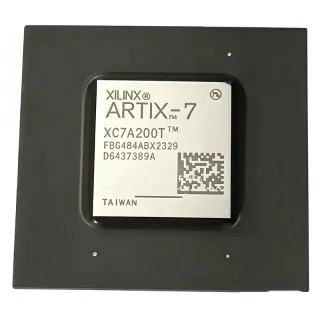
EPF10K130EFC484-2 - FLEX 10KE 130K Gates FPGA | Altera | 484-FBGA
MPN: EPF10K130EFC484-2 ✗ End of Life| Qty | Unit Price | Extended |
|---|---|---|
| 1 | $185 | $185.00 |
| 10 | $165 | $1,650.00 |
| 100 | $142 | $14,200.00 |
| 500 | $121 | $60,500.00 |
| 1,000 | $105 | $105,000.00 |
EPF10K130EFC484-2 Overview
A Field-Programmable Gate Array (FPGA) is a type of programmable logic device (PLD) that contains an array of configurable logic blocks (CLBs), programmable interconnects, and I/O cells, all of which can be reconfigured by the end user after manufacture. The FLEX 10KE architecture belongs to the broader hierarchy: FPGA -> programmable logic -> digital IC -> semiconductor. FPGAs occupy a unique position between fixed-function ASICs (high NRE, low unit cost at volume) and discrete logic (low cost, fixed function), offering hardware-level parallelism with software-driven design flexibility.
Key differentiating features of the EPF10K130EFC484-2 include embedded array blocks (EABs) for on-chip SRAM implementation, multi-volt I/O support for interfacing with 2.5 V and 3.3 V logic, and SameFrame pin migration compatibility across the FLEX 10KE BGA family. The -2 speed grade indicates a balance between performance and power consumption, suitable for cost-sensitive volume production.
Typical applications for the EPF10K130EFC484-2 include telecommunications infrastructure (DSLAM, SONET/SDH framer, ATM switches), network routers and switches, glue logic replacement, bus interface bridging (PCI, UTOPIA, POS-PHY), and DSP co-processing. Its embedded memory blocks make it well-suited for packet buffering, lookup tables, and FIFO implementations.
When designing with this part, verify PCB footprint compatibility using Altera's SameFrame pin-out guide; ensure 2.5 V core and proper I/O bank voltages; and configure the device via the Altera Quartus/MAX+PLUS II toolchain. Note that the FLEX 10KE family is mature and approaching EOL status—long-term availability should be confirmed before new designs.
This page synthesizes distributor pricing, drop-in same-package alternatives within the FLEX 10KE BGA family, and practical design notes not found in a single manufacturer datasheet.
Drop-in alternatives for EPF10K130EFC484-2 — same package, pin-to-pin compatible. Different-package parts requiring PCB rework are excluded.
Variants in this series
Same-series models that are drop-in compatible with EPF10K130EFC484-2 (same form factor and footprint) — differing in Operating Temperature, Speed Grade, Process Technology, Propagation Delay, Configuration Method.
Quick Comparison Tool — Select alternative parts for side-by-side comparison:
EPF10K130EFC484-1
✅ Drop-In✓ In Stock
$92 / Unit
View Datasheet →EPF10K130EFC484-3
✅ Drop-In✓ In Stock
$178.92 / Unit
View Datasheet →EPF10K130EFI484-2
✅ Drop-In ⚠️ 参数待验证✓ In Stock
$92 / Unit
View Datasheet →EPF10K100EFC484-2
✅ Drop-In ⚠️ 参数待验证✓ In Stock
$185.4 / Unit
View Datasheet →EPF10K130EFC484-2N
✅ Drop-In✓ In Stock
$799 / Unit
View Datasheet →EPF10K130EFC484-2X
✅ Drop-In📋 Reference alternative (not in catalog)
EPF10K130EFC484-2 Maximum Ratings & Electrical Characteristics
| Family | FLEX 10KE |
| Logic Elements | 6,656 |
| Equivalent Gates | 130,000 |
| Embedded Memory (bits) | 65,536 |
| User I/O Pins (max) | 369 |
| Maximum Operating Frequency | 333.33 MHz |
| Core Voltage | 2.5 V (±5%) |
| Process Technology | 0.22 µm CMOS |
| Package Type | 484-pin FineLine BGA (FBGA) |
| Package Dimensions | 23 x 23 mm, 1.0 mm pitch |
| Speed Grade | -2 |
| Mounting Type | Surface Mount |
| RoHS Status | unknown |
| Configuration Method | Serial/Parallel via Altera programming tools |
| I/O Standard Support | LVTTL, LVCMOS, PCI, GTL+, SSTL (refer to datasheet) |
EPF10K130EFC484-2 23 x 23 mm, 1.0 mm pitch Pin Configuration Guide
Pin configuration for EPF10K130EFC484-2 (23 x 23 mm, 1.0 mm pitch package). This digital IC includes GPIO, communication interfaces (UART, SPI, I2C), and power pins. Refer to the manufacturer datasheet for alternate pin functions and configuration options. Essential for embedded system design and PCB layout.

No detailed pinout data available for EPF10K130EFC484-2.
Refer to the datasheet for full pin configuration.
Typical Applications
EPF10K130EFC484-2 is suitable for 6 applications: Telecommunications Infrastructure, Network Routers and Switches, Bus Interface Bridging (PCI / UTOPIA / POS-PHY), DSP Co-Processing and FIR Filtering, Industrial Glue Logic Replacement, Legacy Test and Measurement Equipment.
Telecommunications Infrastructure
The EPF10K130EFC484-2 is well-suited for telecom infrastructure such as DSLAM line cards, SONET/SDH framers, and ATM switches. Its 130K gates and 65,536 bits of embedded memory (via EAB blocks) provide sufficient capacity for channelized framing, packet buffering, and lookup-table-based routing. The 369 user I/O pins allow direct interfacing to telecom backplanes with multiple UTOPIA, POS-PHY, or H-MVIP buses, while the 333 MHz internal fMAX handles 155 Mbps OC-3 and 622 Mbps OC-12c tributary processing. Compared with discrete TTL/CMOS glue logic, the FLEX 10KE consolidates bus arbitration, clock distribution, and protocol mapping into a single reconfigurable device—reducing board area and BOM. Note that telecom designs must consider the -2 speed grade headroom against timing closure at the target data rate, and verify SameFrame pin compatibility when migrating across the FLEX 10KE BGA family.
Recommended
Network Routers and Switches
In network routers and Layer-2/3 switches, the EPF10K130EFC484-2 serves as a flexible forwarding-engine fabric. Its 6,656 LEs handle route-table lookups via TCAM-like parallel comparisons implemented in EAB-based dual-port RAM, while the 369 I/O pins accommodate multiple Gigabit Ethernet MAC interfaces via GMII or RGMII bridges. The 2.5 V core voltage simplifies power-tree integration alongside PHY devices and TCAM chips. Designers typically use the FLEX 10KE to implement packet classification, QoS queuing, and ACL matching—tasks that benefit from the device's parallel hardware execution versus software on a network processor. For new switch designs, however, the FLEX 10KE is NRND/EOL; consider Cyclone IV GX or similar modern FPGAs for active-lifecycle alternatives requiring PCB redesign.
Recommended
Bus Interface Bridging (PCI / UTOPIA / POS-PHY)
The EPF10K130EFC484-2 excels at bus-interface bridging between mismatched protocols such as PCI to UTOPIA, PCI to POS-PHY, or MPC860 local bus to DDR-like peripherals. Its EAB-based dual-port RAM blocks implement FIFOs with programmable flag thresholds, while the 6,656 LEs handle protocol state machines and bus arbitration. The 333 MHz fMAX supports 66 MHz PCI and 50 MHz UTOPIA Level-2 operation with margin. Designers leverage the FLEX 10KE's JTAG-based in-system programmability for field upgrades to bridge firmware without board rework—an advantage over fixed-function bridge ASICs. Pin migration across the FLEX 10KE BGA family via Altera's SameFrame scheme allows scaling to higher-density members (e.g., EPF10K250EFC484) on the same PCB footprint when more logic capacity is needed later.
Recommended
DSP Co-Processing and FIR Filtering
For DSP co-processing tasks such as FIR filtering, FFT preprocessing, or video chroma upsampling, the EPF10K130EFC484-2 provides 130K gates of parallel arithmetic logic at 333 MHz—capable of implementing multiply-accumulate (MAC) trees and pipelined FIR filters with sample rates up to ~150 MSPS in 8-bit precision. The EAB memory blocks serve as coefficient ROM and delay-line RAM, while the distributed LE-based registers implement shift-register delays for sample pipelines. Compared to a discrete DSP processor, the FPGA offers deterministic latency and parallel multiplier throughput, ideal for multi-channel audio processing or baseband signal conditioning. Quartus design tools support MegaWizard-based FIR filter generation targeting the FLEX 10KE EAB structure.
Recommended
Industrial Glue Logic Replacement
Industrial control systems, PLCs, and instrumentation frequently use the EPF10K130EFC484-2 as a replacement for discrete 74-series and PAL/GAL glue logic—consolidating dozens of MSI/SSI packages into a single reconfigurable device. With 6,656 LEs, the FLEX 10KE can implement thousands of equivalent gate functions plus state machines, counters, and encoder/decoder logic. The 369 I/O pins comfortably handle 32-bit data buses plus control signals for legacy parallel peripherals (e.g., 8237 DMA, 8255 PPI). For industrial applications requiring extended temperature ranges, the EPF10K130EFC484-2X or EPF10K130EFI484-2 variants are preferred. Designers should budget for EOL risk: confirm long-term supply before committing new industrial designs to the FLEX 10KE family.
Recommended
Legacy Test and Measurement Equipment
Test and measurement instruments—logic analyzers, protocol testers, and ATE fixtures—commonly use the EPF10K130EFC484-2 for pattern generation, timing generation, and bus protocol capture. The device's EAB memory provides deep capture buffers for state/timing analysis, while the high I/O count (369 pins) supports wide parallel stimulus/response buses. The 333 MHz internal fMAX enables generation of high-speed test vectors with precise edge placement via the device's PLL macrocells. For modern replacement of these instruments, the FLEX 10KE is NRND; existing equipment maintenance is the primary use case, sourcing from authorized distributor stock or independent brokers carrying new-old inventory.
Recommended
Recommended Products Summary
Engineering reference data for EPF10K130EFC484-2 — comparison, design guidance, and compliance information.
Selection Guide
Comparison with Alternatives
| Parameter | This Product | EPF10K130EFC484-1 | EPF10K130EFC484-3 | EPF10K130EFC484-2N | EPF10K130EFC484-2X | EPF10K130EFI484-2 | EPF10K100EFC484-2 |
|---|---|---|---|---|---|---|---|
| Package | 484-FBGA (FineLine BGA) | 484-FBGA (FineLine BGA) - same | 484-FBGA (FineLine BGA) - same | 484-FBGA (FineLine BGA) - same | 484-FBGA (FineLine BGA) - same | 484-FBGA (FineLine BGA) - same | 484-FBGA (FineLine BGA) - same |
| Brand | Altera | Altera | Altera | Altera | Altera | Altera | Altera |
| Speed Grade | -2 | -1 (slower) | -3 (faster) | -2 (same, lead-free) | -2 (industrial) | -2 (industrial temp) | -2 (lower density) |
| Logic Elements | 6,656 | 6,656 | 6,656 | 6,656 | 6,656 | 6,656 | 5,120 (~-23%) |
| Equivalent Gates | 130,000 | 130,000 | 130,000 | 130,000 | 130,000 | 130,000 | 100,000 (-23%) |
| Embedded Memory (bits) | 65,536 | 65,536 | 65,536 | 65,536 | 65,536 | 65,536 | 49,152 (-25%) |
| Core Voltage | 2.5 V | 2.5 V | 2.5 V | 2.5 V | 2.5 V | 2.5 V | 2.5 V |
| Temperature Grade | Commercial | Commercial | Commercial | Commercial (lead-free) | Industrial/Extended | Industrial | Commercial |
Key Differentiators
- SameFrame pin compatibility across the FLEX 10KE BGA family (vs EPF10K100EFC484-2)
- Available across multiple temperature/speed grades (vs EPF10K130EFC484-1)
- 65,536 bits of embedded memory via EAB blocks (vs Generic FPGA without block RAM)
Design Notes
The EPF10K130EFC484-2 requires a clean 2.5 V core supply (±5%) with bulk decoupling of at least 100 µF plus 0.1 µF ceramic per power pin group. Estimated: with 130K gates switching at 100 MHz, typical Icc_core can reach 500-700 mA; budget 1 A headroom in the regulator. Use a separate analog 2.5 V rail filtered through a ferrite bead for PLL supply pins (VCCA_PLL) if present. Program I/O bank voltages per bank (1.5 V/1.8 V/2.5 V/3.3 V) according to the Quartus pin planner before generating the programming file.
The 484-FineLine BGA uses 1.0 mm ball pitch and 23 x 23 mm body. Estimated: PCB requires at least 4 routing layers with microvia (or 6 layers with through-via) to fan out the BGA. Use Altera's recommended footprint with NSMD (non-solder mask defined) pads of 0.50 mm diameter. Place decoupling capacitors on the bottom side directly beneath the BGA footprint for shortest loop area. Maintain a continuous ground plane under the device for thermal dissipation and signal return paths.
Do not confuse the EPF10K130EFC484-2 (commercial, standard lead) with the -2N (lead-free) or -2X (industrial temp) variants when ordering—PCBs may have different solder profiles. Configuration requires a serial or parallel PROM (e.g., EPC2LC20) for standalone operation; in-system JTAG programming via Altera ByteBlaster or USB-Blaster is also supported. The FLEX 10KE family is approaching EOL/NRND status; verify long-term supply availability before committing to new production designs.
The 484-FBGA package has an estimated theta_JA of approximately 12-15 C/W with proper PCB thermal vias under the die. At full logic utilization (~80% LE usage at 100 MHz), junction temperature can rise 30-40 C above ambient. For industrial temperature grade applications (-40C to +85C), verify thermal margin via the Altera PowerPlay early power estimator before layout finalization.
Compliance Information
RoHS/REACH status not stated in verified web data; the -2N suffix variant is commonly lead-free. FLEX 10KE family is NRND/EOL per market reports.