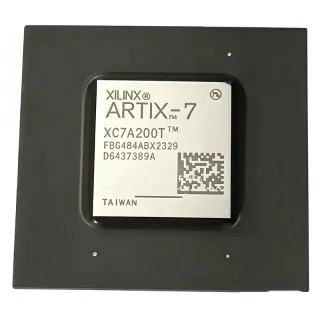
EPF6024AQC240-5 - FLEX 6000 FPGA, 24K Gates, 240-BQFP | Altera
MPN: EPF6024AQC240-5 ✗ End of Life| Qty | Unit Price | Extended |
|---|---|---|
| 1 | $42.5 | $42.50 |
| 10 | $38.2 | $382.00 |
| 100 | $33.75 | $3,375.00 |
| 500 | $29.4 | $14,700.00 |
| 1,000 | $25.9 | $25,900.00 |
EPF6024AQC240-5 Overview
An FPGA (Field Programmable Gate Array) is a type of programmable logic device (PLD) that allows designers to implement arbitrary digital logic through a configuration bitstream loaded into on-chip SRAM. FPGAs occupy a middle ground between fixed-function ASICs (application-specific integrated circuits) and small PLDs such as CPLDs (complex programmable logic devices): unlike ASICs they are reprogrammable in the field, and unlike most CPLDs they offer far higher logic density and embedded memory. The FLEX 6000 family in particular targets cost-sensitive glue-logic, bus-interface bridging, and I/O expansion use cases where high register counts and moderate I/O bandwidth matter more than raw clock rate.
Key specifications of the EPF6024AQC240-5 include the 240-BQFP surface-mount package with a body size of approximately 32 mm × 32 mm, 199 available user I/O pins, and 1,960 logic elements distributed over 196 LABs. The "QC" package suffix indicates a commercial-temperature-range plastic QFP, while "240-5" indicates the 240-pin count and the slowest speed grade. The device operates from a 5 V core supply typical of late-1990s / early-2000s logic designs and supports configuration via Altera's serial or parallel configuration schemes.
Architecturally, the FLEX 6000 family uses a continuous-routing interconnect with distributed look-up table (LUT) logic and dedicated I/O elements. Each LAB contains multiple logic elements, and I/O pins support a range of standards including TTL and CMOS at 3.3 V or 5 V. Embedded array blocks (EABs) provide on-chip ROM/RAM capability for small memory functions, eliminating the need for external memory in many glue-logic designs.
Typical applications for the EPF6024AQC240-5 include industrial glue-logic and bus-bridging boards, legacy telecommunications backplane controllers, military and avionics retrofits that require pin-compatible extended-temperature variants, and prototype ASIC emulation where the 24K-gate density matches the target design. Engineers frequently choose this part for long-lifecycle industrial control systems designed in the late 1990s that are still in production today.
When designing with this device, note that the FLEX 6000 family has reached end-of-life status and is no longer recommended for new designs; designers should evaluate Cyclone or MAX families as modern replacements. Confirm long-term supply and counterfeit risk before specifying in new production, and use the Altera / Intel configuration toolchain (Quartus) for bitstream generation.
This page synthesizes drop-in alternatives, distributor pricing, and design considerations not found in the original manufacturer datasheet - giving engineers a faster path to second-source qualification or legacy board rework.
Drop-in alternatives for EPF6024AQC240-5 — same package, pin-to-pin compatible. Different-package parts requiring PCB rework are excluded.
Variants in this series
Same-series models that are drop-in compatible with EPF6024AQC240-5 (same form factor and footprint) — differing in Package, Speed Grade, Configuration Method, Device Type, Operating Temperature.
Quick Comparison Tool — Select alternative parts for side-by-side comparison:
EPF6024AQC240-4N
✅ Drop-In✓ In Stock
$9.2 / Unit
View Datasheet →EPF6024AQC240-3N
✅ Drop-In✓ In Stock
$69.3 / Unit
View Datasheet →EPF6024AQC240-2N
✅ Drop-In✓ In Stock
$26.1 / Unit
View Datasheet →EPF6024AQC240-1N
✅ Drop-In✓ In Stock
$54 / Unit
View Datasheet →EPF6024AQC240-4
✅ Drop-In✓ In Stock
$61.75 / Unit
View Datasheet →EPF6024AQC240-3
✅ Drop-In✓ In Stock
$19.8 / Unit
View Datasheet →EPF6024AQC240-5 Maximum Ratings & Electrical Characteristics
| Manufacturer | Altera (now Intel FPGA) |
| Family | FLEX 6000 |
| Device Type | SRAM-based FPGA |
| Typical Gates | 24,000 gates (equivalent) |
| Logic Elements | 1,960 |
| Logic Array Blocks (LABs) | 196 |
| User I/O Pins | 199 |
| Package | 240-BQFP (BQFP-240) |
| Mounting Type | Surface Mount |
| Speed Grade | -5 (slowest commercial grade in FLEX 6000 family) |
| Configuration Method | Serial or parallel SRAM configuration |
EPF6024AQC240-5 240-bqfp (bqfp-240) Pin Configuration Guide
Pin configuration for EPF6024AQC240-5 (240-bqfp (bqfp-240) package). This digital IC includes GPIO, communication interfaces (UART, SPI, I2C), and power pins. Refer to the manufacturer datasheet for alternate pin functions and configuration options. Essential for embedded system design and PCB layout.

No detailed pinout data available for EPF6024AQC240-5.
Refer to the datasheet for full pin configuration.
Typical Applications
EPF6024AQC240-5 is suitable for 6 applications: Industrial Glue-Logic and Bus Bridging, Legacy Telecommunications Backplane Controllers, Military and Avionics Retrofit Boards, Prototype ASIC Emulation, I/O Expansion and Custom Peripheral Controllers, Data Acquisition Front-End Controllers.
Industrial Glue-Logic and Bus Bridging
The EPF6024AQC240-5 fits industrial glue-logic and bus-bridging designs because its 24,000-gate capacity, 1,960 logic elements, and 199 user I/O pins provide enough logic and parallel I/O bandwidth to bridge between legacy 8-bit/16-bit microcontrollers and modern 32-bit processors. Typical usage includes address decoding, wait-state insertion, and interrupt aggregation between ISA, PCI, or VME buses in factory-floor controllers. The -5 speed grade is acceptable for bus frequencies under 25 MHz, and the 240-BQFP package's generous I/O count allows direct connection to 32-bit data buses plus control signals without external muxing.
Recommended
Legacy Telecommunications Backplane Controllers
Telecommunications backplanes designed in the late 1990s often used the EPF6024AQC240-5 to implement T1/E1 framer glue logic, HDLC controllers, and time-slot interchangers between DSPs and switch fabrics. The 199 user I/O pins accept parallel backplane data plus control and timing signals without external bus drivers. The 1,960 logic elements are sufficient to implement deep FIFOs and protocol state machines. For long-lifecycle telco deployments, this part remains in service and is typically sourced from obsolete-component distributors.
Recommended
Military and Avionics Retrofit Boards
Military and avionics retrofit programs continue to use the EPF6024AQC240-5 in equipment originally qualified against the FLEX 6000 family datasheet, because requalification against a different FPGA family would require costly re-certification. The 240-BQFP package is robust against vibration and thermal cycling, and the Altera FPGA architecture is well-documented in legacy MIL-STD design references. Design teams typically source this part through authorized obsolete-component brokers with full traceability documentation to meet ITAR and aerospace counterfeit-mitigation requirements.
Recommended
Prototype ASIC Emulation
Engineers use the EPF6024AQC240-5 as a target for ASIC prototyping and pre-silicon validation because its 24,000-gate capacity maps reasonably to small ASICs in the 10K-30K-gate range, and its 199 I/O pins support realistic boundary-scan emulation. The -5 speed grade limits emulation to functional validation rather than at-speed testing, but is adequate for verifying logic correctness before committing to an ASIC mask set. Designers load test vectors through Altera's Quartus II toolchain and use the on-chip SRAM configuration to iterate designs in minutes.
Recommended
I/O Expansion and Custom Peripheral Controllers
The EPF6024AQC240-5 enables I/O expansion and custom peripheral controller designs where microcontrollers lack sufficient GPIO or specialized interface logic. With 199 user I/O pins, the device can implement PWM controllers, quadrature encoder counters, multi-channel UARTs, and parallel LCD interfaces all in one chip. The 1,960 logic elements handle complex state machines that would otherwise require multiple 74-series TTL parts. The 240-BQFP package is large but allows easy hand-prototyping and rework in low-volume industrial products.
Recommended
Data Acquisition Front-End Controllers
Data acquisition systems use the EPF6024AQC240-5 to implement timing generators, channel sequencers, and FIFO controllers between analog front-ends and host processors. The 1,960 logic elements handle state machines for multi-channel scanning, gain ranging, and trigger logic, while the 199 user I/O pins connect directly to 16-bit ADCs and parallel DACs. The -5 speed grade supports sample rates up to approximately 5 MSPS per channel in typical state-machine implementations. Combined with the FLEX 6000 family's embedded array blocks (EABs), it can store calibration tables on-chip.
Recommended
Recommended Products Summary
Engineering reference data for EPF6024AQC240-5 — comparison, design guidance, and compliance information.
Selection Guide
Comparison with Alternatives
| Parameter | This Product | EPF6024AQC240-4N | EPF6024AQC240-3N | EPF6024AQC240-2N | EPF6024AQC240-1N | EPF6024AQC240-4 | EPF6024AQC240-3 |
|---|---|---|---|---|---|---|---|
| Package | 240-BQFP | 240-BQFP (same) | 240-BQFP (same) | 240-BQFP (same) | 240-BQFP (same) | 240-BQFP (same) | 240-BQFP (same) |
| Brand | Altera | Altera | Altera | Altera | Altera | Altera | Altera |
| Speed Grade | -5 (slowest) | -4 | -3 | -2 | -1 (fastest) | -4 | -3 |
| Logic Elements | 1,960 | 1,960 | 1,960 | 1,960 | 1,960 | 1,960 | 1,960 |
| Logic Array Blocks (LABs) | 196 | 196 | 196 | 196 | 196 | 196 | 196 |
| User I/O Pins | 199 | 199 | 199 | 199 | 199 | 199 | 199 |
| Typical Gates (equivalent) | 24,000 | 24,000 | 24,000 | 24,000 | 24,000 | 24,000 | 24,000 |
| Lifecycle Status | Obsolete | Obsolete | Obsolete | Obsolete | Obsolete | Obsolete | Obsolete |
Key Differentiators
- Largest I/O count in FLEX 6000 family (vs EPF6024AQC208 series)
- Lowest cost speed grade in 240-BQFP package (vs EPF6024AQC240-1 (fastest grade))
- Identical silicon to faster speed grades (vs EPF6024AQC240-1N)
- Higher logic density than smaller FLEX 6000 family members (vs EPF6016QC240)
Design Notes
The EPF6024AQC240-5 uses a 5 V core supply typical of late-1990s FPGAs; verify the VCCINT and VCCIO requirements in the FLEX 6000 datasheet before designing the power section. Decouple each VCC pin with a 0.1 uF ceramic capacitor placed within 5 mm of the pin, plus bulk decoupling (47 uF to 100 uF tantalum or aluminum polymer) near the package. Estimate: at 25 MHz toggle rate across 199 I/Os at 5 V CMOS levels, dynamic current can reach 0.5-1 A, so the power supply must deliver at least 1.5 A with adequate headroom.
The 240-BQFP package has a junction-to-ambient thermal resistance (theta_JA) of approximately 25-35 C/W for typical 4-layer boards, depending on copper area. Estimate: at 1.5 A total supply current at 5 V (7.5 W dissipation) with 25 C/W theta_JA, junction temperature rise is approximately 188 C above ambient, which would exceed the commercial 70 C junction limit. For real designs, average power is much lower (0.5-2 W typical), but confirm with worst-case toggle-rate estimation. Add copper pours under the package and use airflow if needed.
Do not assume newer Quartus versions support FLEX 6000; Quartus II 9.1 SP2 or Quartus II 13.0sp1 with legacy support is the last known working toolchain. Modern USB-Blasters are compatible, but ensure driver installation. Watch for counterfeit risk - obsolete FPGAs are a frequent target; insist on traceability documents and visual inspection of unused inventory. The 240-BQFP package is large (32 mm × 32 mm body) and prone to PCB warpage during reflow; use balanced copper and follow JEDEC J-STD-020 MSL handling.
The 240-BQFP package has 0.5 mm or 0.635 mm pitch leads on all four sides - confirm the exact lead pitch from the mechanical drawing before designing the land pattern. Route signals between lands on inner layers with care, since BQFP packages have many leads and limited routing channels. Place configuration-related pins (nCONFIG, nSTATUS, CONF_DONE, DCLK, DATA0) in groups near the configuration device for shortest traces. Keep clock inputs short and away from I/O switching signals to minimize jitter.
Compliance Information
Compliance information for EPF6024AQC240-5 was not present in the retrieved web data; the FLEX 6000 family was originally designed before RoHS became mandatory, so most variants are non-compliant unless specifically marked lead-free. Set all compliance fields to unknown pending direct datasheet review.