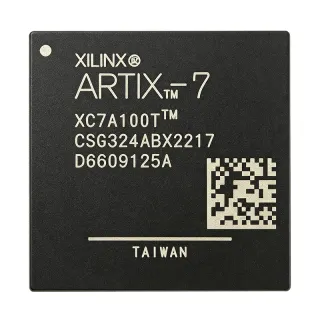
EP20K400EFC672-1 - APEX 20KE FPGA 400K Gates 672-FBGA | Intel
MPN: EP20K400EFC672-1 ✗ End of Life| Qty | Unit Price | Extended |
|---|---|---|
| 1 | $185 | $185.00 |
| 10 | $165 | $1,650.00 |
| 100 | $145 | $14,500.00 |
| 500 | $125 | $62,500.00 |
| 1,000 | $110 | $110,000.00 |
EP20K400EFC672-1 Overview
An FPGA (Field Programmable Gate Array) is a type of programmable logic device (PLD) that lets designers implement custom digital logic after PCB fabrication. Within the broader semiconductor taxonomy, FPGAs sit above CPLDs and below fixed-function ASICs in design flexibility. The APEX 20KE family was Altera's flagship high-density platform before the Stratix era, and was widely adopted for telecom, networking, and DSP prototyping designs of the late 1990s and early 2000s.
Key features of the EP20K400EFC672-1 include 488 user I/O pins, up to 212,992 bits of embedded SRAM, a 1.8V core supply with 2.5V/3.3V tolerant I/O, and support for multiple I/O standards including LVTTL, LVCMOS, PCI, SSTL, and HSTL. The -1 speed grade corresponds to a 368 MHz internal operation. The MultiCore architecture integrates LUT-based logic, embedded array blocks (EABs) for memory, and product-term logic for fast register-intensive functions.
Typical applications include high-speed telecommunications backplanes, ASIC prototyping, digital signal processing pipelines, network switching fabrics, and embedded control systems where hundreds of thousands of gates are needed without the NRE cost of an ASIC. The device supports in-system programmability via JTAG and Altera's MAX+PLUS II or Quartus design flows.
When designing with the EP20K400EFC672-1, careful PCB layout is critical because the 672-ball FC-FBGA package requires microvia technology and controlled-impedance routing. Engineers should provide multiple decoupling capacitors near the balls, follow Intel/Altera's reference decoupling guidelines, and validate signal integrity on high-speed I/O using IBIS models.
This page synthesizes current distributor pricing, drop-in same-brand alternatives, and engineering context not found in the original manufacturer datasheet, helping procurement and design engineers make informed lifecycle decisions.
Drop-in alternatives for EP20K400EFC672-1 — same package, pin-to-pin compatible. Different-package parts requiring PCB rework are excluded.
Variants in this series
Same-series models that are drop-in compatible with EP20K400EFC672-1 (same form factor and footprint) — differing in Operating Temperature, Process Technology, Package, Family, Speed Grade.
Quick Comparison Tool — Select alternative parts for side-by-side comparison:
EP20K400EFC672-1X
✅ Drop-In📋 Reference alternative (not in catalog)
EP20K400EFC672-1N
✅ Drop-In✓ In Stock
$175 / Unit
View Datasheet →EP20K400EFC672-2
✅ Drop-In✓ In Stock
$92.75 / Unit
View Datasheet →EP20K400EFC672-3
✅ Drop-In✓ In Stock
$199.5 / Unit
View Datasheet →EP20K400EFC672-2X
✅ Drop-In ⚠️ 参数待验证✓ In Stock
$118.9 / Unit
View Datasheet →EP20K400EFC672-1 Maximum Ratings & Electrical Characteristics
| Family | APEX 20KE |
| System Gates | 400,000 |
| Logic Elements / Cells | 16,640 |
| Maximum User I/O | 488 |
| Embedded Memory | 212,992 bits |
| Core Voltage | 1.8 V |
| I/O Voltage Tolerance | 2.5 V / 3.3 V compatible |
| Technology | 0.22 um CMOS |
| Propagation Delay | 2.5 ns |
| Internal Operating Frequency | 368 MHz |
| Speed Grade | -1 |
| Package | 672-FBGA (FineLine BGA) |
| Mounting Type | Surface Mount |
| Operating Temperature | 0C to +85C (Commercial) |
| Logic Family | CMOS |
| Architecture | MultiCore (LUT + EAB + product-term) |
EP20K400EFC672-1 672-fbga (fineline bga) Pin Configuration Guide
Pin configuration for EP20K400EFC672-1 (672-fbga (fineline bga) package). This digital IC includes GPIO, communication interfaces (UART, SPI, I2C), and power pins. Refer to the manufacturer datasheet for alternate pin functions and configuration options. Essential for embedded system design and PCB layout.

No detailed pinout data available for EP20K400EFC672-1.
Refer to the datasheet for full pin configuration.
Typical Applications
EP20K400EFC672-1 is suitable for 7 applications: Telecommunications Backplane Design, ASIC Prototyping and Emulation, Digital Signal Processing Pipelines, Network Switching and Router Line Cards, Industrial Control and Automation, Legacy Avionics and Defense Systems, Test and Measurement Instrumentation.
Telecommunications Backplane Design
The EP20K400EFC672-1 was a workhorse for telecom backplane designs of the late 1990s and early 2000s, where its 400K system gates and 488 user I/Os let engineers integrate link-layer processing, framer logic, and glue logic onto a single programmable device. The 672-FBGA package exposed enough I/O to terminate multiple parallel data buses plus JTAG and clock distribution, while 212,992 bits of embedded SRAM buffered packet headers and lookup tables without external memory. Compared with a CPLD, the APEX 20KE MultiCore architecture delivers higher fMAX on register-intensive datapaths, which matters at the 50-155 MHz backplane speeds of that era. Modern replacements (Cyclone V, Stratix) are recommended only when redesigning; otherwise, the -1 speed grade continues to support legacy systems in production. Reference: Altera APEX 20KE datasheet, Altera AN-119 application note.
Recommended
ASIC Prototyping and Emulation
Before modern ASIC prototyping platforms, the EP20K400EFC672-1 was used to emulate mid-complexity ASICs - its 16,640 logic elements and 212,992-bit embedded memory were sufficient to map entire subsystems for pre-silicon validation. The MultiCore architecture's product-term blocks accelerated control-path logic that LUT-only fabrics struggled with, giving faster functional verification at the cost of higher unit price. The 488 user I/Os allowed emulating wide internal buses, and the 1.8V core with multi-voltage I/O simplified bridging between legacy 3.3V peripherals and modern sub-micron ASICs being validated. For new prototyping flows, designers should evaluate modern FPGAs, but existing APEX 20KE-based emulators remain in service for legacy ASICs. The -1 speed grade offers the slowest propagation delay in the family; upgrade to -2 or -3 for tighter timing emulation margins. Reference: Altera AN-191 (prototyping with APEX 20K).
Recommended
Digital Signal Processing Pipelines
DSP pipelines were a primary application for the EP20K400EFC672-1 because its 16,640 logic elements comfortably fit FIR filters, FFT butterflies, and custom MAC arrays, while 212,992 bits of embedded SRAM held coefficient banks and intermediate samples. With 488 user I/Os, the device could interface to multiple parallel ADC/DAC buses plus external SRAM/SDRAM, and the 1.8V core supply kept dynamic power lower than older 5V FPGAs. At 368 MHz internal frequency and 2.5 ns propagation delay, the -1 speed grade handled audio-rate and baseband DSP for telecom and instrumentation. Designers built multiplier-rich datapaths using the embedded array blocks (EABs), trading logic elements for hardware multipliers implemented via memory. Modern DSP blocks in Cyclone/Stratix devices are dramatically faster, but the EP20K400EFC672-1 remains a viable baseline in legacy DSP products. Reference: Altera AN-141 (DSP implementation in APEX).
Recommended
Network Switching and Router Line Cards
Router and switch line cards of the early 2000s used the EP20K400EFC672-1 to implement queuing logic, lookup-table controllers, and fabric interfaces. With 488 user I/Os, the device could terminate a 32-bit UTOPIA / POS-PHY bus plus an SPI-4.2 link, while 212,992 bits of embedded SRAM held forwarding-table caches and queue descriptors. The 1.8V core and 2.5V/3.3V-tolerant I/O simplified interfacing to both legacy 3.3V PHYs and modern sub-micron switch fabrics. The MultiCore architecture's product-term logic gave fast priority encoders and TCAM-like lookup engines, which LUT-only FPGAs implemented less efficiently. At 368 MHz internal frequency, the -1 speed grade supported 100 Mbps to 1 Gbps line rates common at that time. New designs should use Cyclone V or Stratix V devices, but the EP20K400EFC672-1 continues to ship in installed telecom bases. Reference: Altera APEX 20KE datasheet, Altera AN-213 (network applications).
Recommended
Industrial Control and Automation
Industrial controllers used the EP20K400EFC672-1 for machine vision preprocessing, motor control loops, and multi-axis PLCs where its 16,640 logic elements and 488 user I/Os replaced racks of 74-series glue logic. The 1.8V core with 3.3V-tolerant I/O simplified interfacing to 5V sensors via external level shifters, and the 212,992-bit embedded SRAM held encoder tables and PID loop constants. With 488 user I/Os, the device could terminate multiple encoder interfaces, PWM channels, and fieldbus connections (Profibus, DeviceNet) on a single chip. The 0C to 85C commercial temperature range was adequate for indoor cabinets, while the -1X variant supported harsher factory-floor conditions. For new industrial designs, modern Cyclone IV/V parts offer RoHS compliance and active toolchain support, but legacy APEX 20KE-based controllers remain in installed production lines. Reference: Altera AN-209 (industrial control with APEX 20K).
Recommended
Legacy Avionics and Defense Systems
Avionics subsystems and defense electronics adopted the EP20K400EFC672-1 because its 400K-gate capacity fit mission-computing, radar preprocessing, and secure-comm interfaces in a single BGA. The 488 user I/Os handled MIL-STD-1553 databuses, ARINC 429 channels, and custom backplane interfaces, while 212,992 bits of embedded SRAM stored waveform tables and crypto key caches. The MultiCore architecture's product-term blocks accelerated state-machine logic that LUT-only fabrics handled inefficiently, while 1.8V core with 2.5V/3.3V I/O simplified interfacing to legacy bus drivers. Modern avionics designs require DO-254 certification and prefer newer FPGAs, but many fielded systems continue to operate on the EP20K400EFC672-1. The -1X extended-temperature variant is preferred in avionics for wider thermal margin. Reference: Altera APEX 20KE datasheet, Altera white paper on MIL-STD applications.
Recommended
Test and Measurement Instrumentation
Test equipment manufacturers used the EP20K400EFC672-1 as the timing engine for protocol analyzers, logic analyzers, and bit-error-rate testers because its 488 user I/Os and 16,640 logic elements fit complex pattern-generation and capture logic on a single device. The 212,992-bit embedded SRAM held deep capture buffers, while the 1.8V core with multi-voltage I/O simplified interfacing to both legacy 5V probe pods and modern sub-micron SerDes front ends. At 368 MHz internal frequency and 2.5 ns propagation delay, the -1 speed grade captured and generated signals at hundreds of MHz with deterministic timing. The MultiCore architecture's EABs implemented deep FIFO and pattern-table memory directly in fabric, eliminating external SRAM in many designs. New test equipment should use modern FPGAs with transceivers, but legacy APEX 20KE-based instruments remain common in labs. Reference: Altera APEX 20KE datasheet, Altera AN-223 (test instrumentation).
Recommended
Recommended Products Summary
Engineering reference data for EP20K400EFC672-1 — comparison, design guidance, and compliance information.
Selection Guide
Comparison with Alternatives
| Parameter | This Product | EP20K400EFC672-1X | EP20K400EFC672-1N | EP20K400EFC672-2 | EP20K400EFC672-3 | EP20K400EFC672-2X |
|---|---|---|---|---|---|---|
| Brand | Intel (formerly Altera) | Intel (formerly Altera) | Intel (formerly Altera) | Intel (formerly Altera) | Intel (formerly Altera) | Intel (formerly Altera) |
| Package | 672-FBGA (FineLine BGA) | 672-FBGA - same | 672-FBGA - same | 672-FBGA - same | 672-FBGA - same | 672-FBGA - same |
| Speed Grade | -1 (slowest) | -1X (extended temp, same speed) | -1N (lead-free, same speed) | -2 (faster) | -3 (fastest) | -2X (faster, extended temp) |
| System Gates | 400,000 | 400,000 | 400,000 | 400,000 | 400,000 | 400,000 |
| Logic Elements | 16,640 | 16,640 | 16,640 | 16,640 | 16,640 | 16,640 |
| User I/O | 488 | 488 | 488 | 488 | 488 | 488 |
| Embedded SRAM | 212,992 bits | 212,992 bits | 212,992 bits | 212,992 bits | 212,992 bits | 212,992 bits |
| Core Voltage | 1.8 V | 1.8 V | 1.8 V | 1.8 V | 1.8 V | 1.8 V |
| Operating Temperature | 0C to +85C | Extended/industrial | 0C to +85C (lead-free) | 0C to +85C | 0C to +85C | Extended/industrial |
Key Differentiators
- Broader temperature options within the same footprint (vs EP20K400EFC672-2)
- Lowest cost among APEX 20KE 672-FBGA family (vs EP20K400EFC672-3)
- Same 672-FBGA footprint across the entire EP20K400E family (vs EP20K400EBC652-1)
Design Notes
The 672-ball FineLine BGA requires microvia PCB technology (typically laser-drilled microvias in 4-6 layer stackups) because of the 1.00 mm ball pitch. Use a symmetrical stackup with reference planes on layers 2 and N-1 to provide controlled-impedance signal return paths, and follow Intel/Altera's recommended decoupling of 0.1 uF and 0.01 uF capacitors placed within 100 mils of each power pin.
High-speed I/O on the EP20K400EFC672-1 (LVTTL, LVCMOS, PCI, SSTL, HSTL) demands impedance-controlled traces (typically 50 ohm single-ended, 100 ohm differential). Validate signal integrity using IBIS models from Altera, simulate with HyperLynx or SiSoft QCD, and reserve space for series-termination resistors near driver pins. Length-matching within 100 mils for parallel buses avoids setup/hold violations at 368 MHz internal frequency.
Do not confuse the 672-ball FC-FBGA package of the EP20K400EFC672-1 with the 652-ball variants of the same die (EP20K400EBC652 family). The ball maps differ and the parts are NOT pin-compatible - using a 652-ball footprint will short power to ground. Also confirm whether your design uses the -1, -1X, or -1N suffix because the temperature grade and lead-free status differ; misordering the wrong suffix can result in field failures outside 0C to 85C.
Estimated: at 1.8V core with 50% logic utilization at 368 MHz, the EP20K400EFC672-1 dissipates approximately 3-5 W. The 672-FBGA package has limited heatsink options; design thermal management around a minimum 4-layer PCB with continuous internal copper planes stitched to the ground balls, and consider small clip-on heatsinks if operating above 70C ambient. Monitor VCCINT rail under worst-case vector patterns.
Compliance Information
APEX 20KE family pre-dates RoHS mandates; -1N suffix variants are explicitly lead-free. RoHS/REACH compliance not stated in current distributor listings - request declaration from distributor. AEC-Q100 is not applicable (industrial/commercial FPGA, not automotive-qualified).