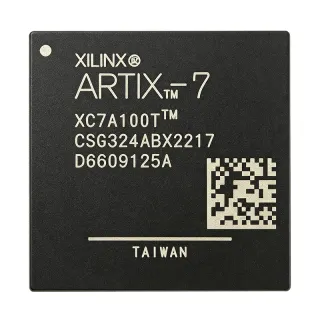
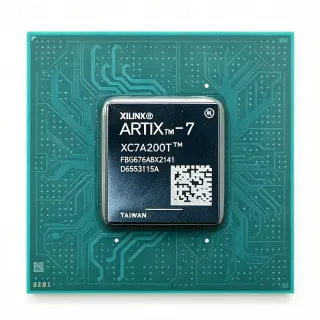
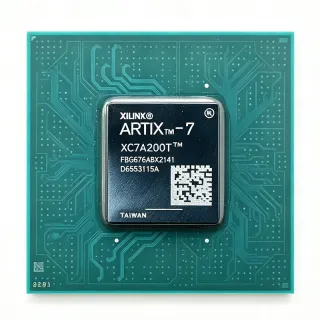
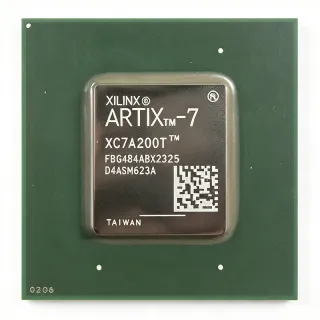
EP4CE55F29C8LN - Cyclone IV E FPGA 55K LE 780-FBGA | Intel
MPN: EP4CE55F29C8LN ✓ Active| Qty | Unit Price | Extended |
|---|---|---|
| 1 | $118.5 | $118.50 |
| 10 | $109 | $1,090.00 |
| 100 | $95.4 | $9,540.00 |
| 500 | $86.2 | $43,100.00 |
| 1,000 | $78.9 | $78,900.00 |
EP4CE55F29C8LN Overview
What is a Cyclone IV E FPGA? Cyclone IV E is the non-transceiver member of Intel's Cyclone IV family, a low-cost, low-power FPGA line architected for high-volume, power-sensitive applications such as industrial control, video processing, and consumer electronics. As an SRAM-based programmable logic device, it sits in the broader hierarchy of programmable logic (FPGA -> programmable logic -> logic IC -> integrated circuit -> semiconductor), and bridges the gap between fixed-function ASICs and microcontrollers when deterministic parallel performance is required.
Key differentiating features of the EP4CE55F29C8LN include 55,856 logic elements (the mid-density option in the family), 2,396,160 bits of embedded RAM for buffering and FIFO storage, 156 hardware 18x18 multipliers that accelerate DSP and video scaling pipelines, and 4 general-purpose PLLs for clock synthesis. The device supports multiple I/O standards including LVDS, LVTTL, LVCMOS, SSTL, and HSTL, enabling direct interfacing with DDR/DDR2 memory and a wide range of peripherals without external translation.
Technically, the Cyclone IV E architecture combines Logic Array Blocks (LABs) of 16 Logic Elements each, MLABs (Memory LABs) that double as distributed RAM, and embedded M9K memory blocks. Configuration is loaded via JTAG or Active Serial (AS) modes from EPCS or EPCQ flash, with built-in decompression for compressed bitstreams. The 1.2 V core is paired with on-chip voltage regulators that accept a single 3.3 V or 2.5 V supply, simplifying power-tree design on the PCB.
Typical applications include industrial motor and motion control, video bridging and image processing, telecommunications line cards, broadcast equipment, and PCIe endpoint expansion. The 780-ball FBGA package with 1.0 mm ball pitch suits boards where moderate IO count, mid-range logic density, and reliable manufacturability are required simultaneously.
When designing with this device, plan power sequencing so the 3.3 V analog supply ramps before the 1.2 V core, and use Intel's PowerPlay early-power estimator (EPE) before final pin assignment to verify thermal envelopes. Pin migration from the C7/C9 speed grades is straightforward, but PCIe hard IP availability should be re-validated in Quartus II 13.1 or later.
This page synthesizes distributor pricing, drop-in alternative MPNs sharing the F29 780-FBGA footprint, and practical design guidance that goes beyond the Cyclone IV Device Handbook content.
Drop-in alternatives for EP4CE55F29C8LN — same package, pin-to-pin compatible. Different-package parts requiring PCB rework are excluded.
Variants in this series
Same-series models that are drop-in compatible with EP4CE55F29C8LN (same form factor and footprint) — differing in Package, Process Technology, Operating Temperature, Speed Grade, Configuration Modes.
Quick Comparison Tool — Select alternative parts for side-by-side comparison:
EP4CE55F29C8L
✅ Drop-In✓ In Stock
$150 / Unit
View Datasheet →EP4CE55F29C8
✅ Drop-In✓ In Stock
$95.41 / Unit
View Datasheet →EP4CE55F29C7N
✅ Drop-In✓ In Stock
$138 / Unit
View Datasheet →EP4CE55F29C7
✅ Drop-In✓ In Stock
$132.4 / Unit
View Datasheet →EP4CE55F29C6N
✅ Drop-In✓ In Stock
$49.95 / Unit
View Datasheet →EP4CE55F29C6
✅ Drop-In✓ In Stock
$154.2 / Unit
View Datasheet →EP4CE55F29C8LN Maximum Ratings & Electrical Characteristics
| Device Family | Cyclone IV E |
| Logic Elements (LE) | 55,856 |
| Logic Array Blocks (LAB) | 3,491 |
| Embedded Memory | 2,396,160 bits |
| Embedded 18x18 Multipliers | 156 |
| Maximum User I/Os | 374 |
| PLLs | 4 |
| Global Clocks | 20 |
| Process Technology | 60 nm (TSMC low-power) |
| Core Voltage | 1.2 V |
| Supply Voltage (VCCINT) | 1.0 V to 1.2 V |
| Package | 780-ball FBGA (F29), 1.0 mm pitch |
| Temperature Grade | Commercial 0C to +85C |
| Speed Grade | 8 |
| Configuration Modes | Active Serial, JTAG, Passive Serial |
EP4CE55F29C8LN 780-ball fbga (f29), 1.0 mm pitch Pin Configuration Guide
Pin configuration for EP4CE55F29C8LN (780-ball fbga (f29), 1.0 mm pitch package). This digital IC includes GPIO, communication interfaces (UART, SPI, I2C), and power pins. Refer to the manufacturer datasheet for alternate pin functions and configuration options. Essential for embedded system design and PCB layout.

No detailed pinout data available for EP4CE55F29C8LN.
Refer to the datasheet for full pin configuration.
Typical Applications
EP4CE55F29C8LN is suitable for 6 applications: Industrial Motor and Motion Control, Video Bridging and Image Processing, Telecommunications Line Cards, Broadcast and Studio Equipment, Industrial Machine Vision and Inspection, Portable and Battery-Powered Instruments.
Industrial Motor and Motion Control
The EP4CE55F29C8LN is well suited for industrial motor and motion control because its 156 embedded 18x18 hardware multipliers accelerate Field-Oriented Control (FOC) algorithms with single-cycle multiply-accumulate throughput, while 4 PLLs synthesize independent timing domains for encoder feedback, PWM switching, and EtherCAT or Modbus communication. With 55,856 logic elements the device handles multi-axis vector control and resolver decoding on a single chip, and the 374 user I/Os drive gate drivers, current sensors, and fault inputs without external logic. Cyclone IV E devices power millions of variable-frequency drives and servo controllers globally.
Recommended
Video Bridging and Image Processing
For video bridging, the EP4CE55F29C8LN delivers 156 hardware 18x18 multipliers that implement parallel FIR filters, scaling engines, and color-space converters in real time. The 2,396,160 bits of embedded M9K memory act as line buffers for HD video at 60 Hz without external SRAM, and the 374 I/Os accept LVDS pairs for direct camera-link or HDMI bridging. Designers use Cyclone IV E for medical imaging consoles, surveillance DVRs, and machine-vision pick-and-place controllers where deterministic low-latency video pipelines are required.
Recommended
Telecommunications Line Cards
In telecom line cards, the EP4CE55F29C8LN serves as a packet-classification, traffic-shaping, or LIU-interface glue device. Its 4 PLLs generate jitter-clean clocks recovered from network references, and 20 global clock networks distribute timing across hundreds of SERDES-free parallel interfaces. The 55,856 logic elements implement protocol-aware state machines for TDM, HDLC, or GFP framing, and the 780-FBGA package offers 374 I/Os to aggregate multiple E1/T1 or 1G Ethernet ports without a companion bridge chip.
Recommended
Broadcast and Studio Equipment
The EP4CE55F29C8LN is used in broadcast audio routers, SDI embedders, and studio timing generators. Its DSP blocks deliver simultaneous compression and limiting across 32+ audio channels, while LVDS-capable I/Os drive SDI serializers at 270 Mb/s or 1.485 Gb/s. Cyclone IV E devices are common in OB-van mixers, video walls, and waveform monitors where deterministic latency matters. The 1.2 V core and on-chip regulators simplify thermally constrained 1U rack chassis.
Recommended
Industrial Machine Vision and Inspection
For machine-vision inspection stations, the EP4CE55F29C8LN performs Bayer decoding, defect detection, and conveyor synchronization in parallel. The 156 hardware multipliers execute Sobel, Laplacian, and FFT kernels at full camera frame rate, while 2,396 Kbits of embedded memory buffer full Bayer frames before feature extraction. The 780-FBGA package supports multi-lane MIPI-CSI2 or Camera-Link bridging through FPGA soft IPs. Vision OEMs deploy Cyclone IV E for pick-and-place, AOI, and label-inspection machines.
Recommended
Portable and Battery-Powered Instruments
The EP4CE55F29C8LN operates from a 1.2 V core at sub-1 W typical power, making it a fit for portable test instruments and handheld diagnostic tools. Its 4 PLLs and on-chip regulators accept a single 3.3 V supply, eliminating multiple switching regulators and saving board area. The 55,856 logic elements run DSP-heavy signal-processing flows - FFTs, digital filters, and protocol decoding - while the 780-FBGA package supports high-pin-count LCDs and touchscreen controllers in handhelds. Designers value Cyclone IV E for oscilloscope front-ends and field-network analyzers.
Recommended
Recommended Products Summary
Engineering reference data for EP4CE55F29C8LN — comparison, design guidance, and compliance information.
Selection Guide
Comparison with Alternatives
| Parameter | This Product | EP4CE55F29C8L | EP4CE55F29C7N | EP4CE55F29C6N |
|---|---|---|---|---|
| Brand | Intel (formerly Altera) | Intel | Intel | Intel |
| Package | 780-FBGA (F29) | 780-FBGA (F29) - same | 780-FBGA (F29) - same | 780-FBGA (F29) - same |
| Logic Elements | 55,856 | 55,856 | 55,856 | 55,856 |
| Embedded Memory (bits) | 2,396,160 | 2,396,160 | 2,396,160 | 2,396,160 |
| 18x18 Multipliers | 156 | 156 | 156 | 156 |
| Maximum User I/Os | 374 | 374 | 374 | 374 |
| Speed Grade | 8 | 8 | 7 (faster Fmax) | 6 (fastest Fmax) |
| Temperature Grade | Commercial (0C to +85C) | Commercial | Commercial | Commercial |
| RoHS / Lead-Free | Yes (L suffix) | Yes (L) | No (N suffix) | No (N suffix) |
| Configuration Flash (typical) | EPCS16 or EPCQ32 | Same | Same | Same |
Key Differentiators
- Lead-free RoHS-compliant termination (vs EP4CE55F29C8N)
- Speed grade 8 vs 7 Fmax trade-off (vs EP4CE55F29C7N)
- Same 780-FBGA footprint as larger/smaller family siblings (vs EP4CE55F23C8LN)
Design Notes
The Cyclone IV E EP4CE55F29C8LN accepts a single 3.3 V supply through its on-chip linear regulators; the 1.2 V VCCINT rail is generated internally, simplifying the power tree. Plan a 4-layer PCB with a dedicated 3.3 V plane, and place 100 nF + 10 uF decoupling pairs within 5 mm of every VCCIO/VCCINT ball cluster. Estimated: at 50% toggle rate on 200 user I/Os, the device draws approximately 0.8 A from VCCINT and 0.4 A from VCCIO, so use a 1.5 A-rated 3.3 V LDO.
Estimated: with theta_JA of 14 C/W (still air, JEDEC JESD51) and 1.5 W worst-case power, junction-to-ambient rise is 21C - commercial-grade junction limit (125C) is comfortably met. For enclosed chassis with no airflow, derate by 0.2 C/W per degree of ambient rise above 50C. Place thermal vias under the central 6x6 ball grid of the FBGA to spread heat into inner copper layers.
The 780-FBGA package uses 1.0 mm ball pitch - design rules require 0.5 mm pad diameter with 0.4 mm via-in-pad microvias (laser-drilled, copper-filled). Use a 1.6 mm board stack-up with 1 oz copper on outer layers; route differential pairs (LVDS) on the top layer with 100 ohm differential impedance and 50 ohm single-ended. Avoid routing signals through the central BGA ball array; escape on the two outer rings first.
Do not connect JTAG TCK to a free-running oscillator - add a 1 kohm pull-down to keep TCK low during configuration. Use only the recommended EPCS16, EPCS64, or EPCQ32 configuration flashes; third-party SPI flashes require a Quartus II programming-file conversion step. Confirm the active 'CONF_DONE' LED pulls high within 100 ms of POR; longer delays indicate a corrupted bitstream or incorrect MSEL pin settings.
Cyclone IV E LVDS inputs require 100 ohm differential termination across the receiver pair; place the resistor within 7 mm of the FPGA ball. For DDR/DDR2 interfaces, use the dedicated DQS/DQ groups and follow the Cyclone IV External Memory Interface Handbook pin-out rules - swapping byte lanes causes severe setup/hold violations that the TimeQuest timing analyzer may not flag until hardware validation.
Compliance Information
Lead-free 'L' suffix indicates RoHS compliance per the Cyclone IV Device Handbook. Industrial temperature variants (I suffix) are recommended for AEC-Q100 applications but the part itself is not AEC-Q100 qualified - validate at the system level.