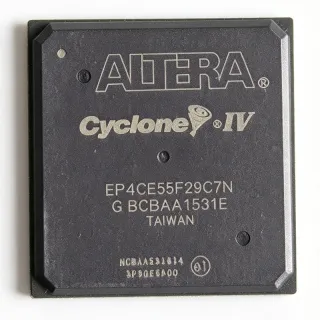
EP4CE75F29I7N - Cyclone IV E FPGA, 75K LE, F780 BGA | Intel
MPN: EP4CE75F29I7N ✓ Active| Qty | Unit Price | Extended |
|---|---|---|
| 1 | $679.47 | $679.47 |
| 10 | $645.5 | $6,455.00 |
| 100 | $605 | $60,500.00 |
| 250 | $575 | $143,750.00 |
| 500 | $540 | $270,000.00 |
EP4CE75F29I7N Overview
A Field-Programmable Gate Array (FPGA) is a semiconductor device built around an array of configurable logic blocks (CLBs) connected by a programmable interconnect matrix. FPGAs sit between microcontrollers and ASICs in the design hierarchy, offering hardware-level parallelism, deterministic latency, and in-system reprogrammability for applications ranging from industrial motor control to video bridging. The Cyclone IV E family is Intel's low-cost, low-power line for high-volume cost-sensitive designs.
Key features include 75,408 logic elements, 281 Kbits of embedded memory, 426 multipliers (18x18), 4 PLLs, and 426 Kbits of M9K block RAM. The device supports LVDS, LVCMOS, SSTL, and HSTL I/O standards across 8 banks, with per-pin dynamic phase alignment and DDR/DDR2/DDR3 external memory interfaces. The F780 package offers 426 user I/O pins for high-pin-count designs.
Architecturally, the Cyclone IV E family shares the same LE structure and MultiTrack interconnect as its Cyclone III predecessor but adds on-chip termination (OCT) calibration and improved signal integrity. Logic elements include 4-input look-up tables (LUTs), dedicated carry logic, and embedded memory, while the MultiTrack interconnect provides routing across row, column, and register chains.
Typical applications include industrial motor control, video surveillance systems, automotive infotainment prototypes, telecommunications line cards, and consumer display controllers. The wide logic capacity, DSP blocks, and external memory support also suit software-defined radio front-ends, machine vision interfaces, and PCIe Gen1 endpoint bridging.
When designing with this device, ensure the Quartus II Prime toolchain is configured for the F780 package and 1.2 V core supply. JTAG, Active Serial, and Fast Passive Parallel configuration modes are supported; on-board decoupling of at least 100 uF bulk capacitance near each power pin is recommended for stable operation.
This page synthesizes distributor pricing, drop-in package-same FPGAs, and practical design notes not found in the manufacturer datasheet alone, helping engineers compare the EP4CE75F29I7N against other Cyclone IV E and Cyclone IV GX family members.
Drop-in alternatives for EP4CE75F29I7N — same package, pin-to-pin compatible. Different-package parts requiring PCB rework are excluded.
Variants in this series
Same-series models that are drop-in compatible with EP4CE75F29I7N (same form factor and footprint) — differing in Package, Process Technology, Operating Temperature, Configuration Modes, Speed Grade.
Quick Comparison Tool — Select alternative parts for side-by-side comparison:
EP4CE75F29I7
✅ Drop-In✓ In Stock
$121.3 / Unit
View Datasheet →EP4CE115F29I7N
✅ Drop-In📋 Reference alternative (not in catalog)
EP4CE55F29I7N
✅ Drop-In✓ In Stock
$154.8 / Unit
View Datasheet →EP4CE40F29I7N
✅ Drop-In✓ In Stock
$124 / Unit
View Datasheet →EP4CE75F29C7N
✅ Drop-In✓ In Stock
$152.7 / Unit
View Datasheet →EP4CE75F29C8N
✅ Drop-In✓ In Stock
$149.75 / Unit
View Datasheet →EP4CE75F29I7N Maximum Ratings & Electrical Characteristics
| Family | Cyclone IV E |
| Logic Elements (LE) | 75,408 |
| Embedded Memory (bits) | 2,810,880 |
| Logic Array Blocks (LAB) | 4,633 |
| Embedded 18x18 Multipliers | 426 |
| PLLs | 4 |
| Global Clocks | 20 |
| Maximum User I/O Pins | 426 |
| I/O Banks | 8 |
| Package | 780-ball FBGA (F29) |
| Mounting Type | Surface Mount |
| Operating Temperature | -40C to +100C (Industrial) |
| Core Voltage | 1.2 V |
| Process Technology | 60 nm low-k |
| RoHS Status | Compliant |
EP4CE75F29I7N 780-ball fbga (f29) Pin Configuration Guide
Pin configuration for EP4CE75F29I7N (780-ball fbga (f29) package). This digital IC includes GPIO, communication interfaces (UART, SPI, I2C), and power pins. Refer to the manufacturer datasheet for alternate pin functions and configuration options. Essential for embedded system design and PCB layout.

No detailed pinout data available for EP4CE75F29I7N.
Refer to the datasheet for full pin configuration.
Typical Applications
EP4CE75F29I7N is suitable for 8 applications: Industrial Motor Control, Video Surveillance Systems, Telecommunications Line Cards, Automotive Infotainment Prototyping, Software-Defined Radio Front-End, Machine Vision Interfaces, LED Display Controllers, PCIe Gen1 Endpoint Bridging.
Industrial Motor Control
The EP4CE75F29I7N fits industrial motor control applications where 75,408 logic elements and 426 (18x18) multipliers deliver field-oriented control (FOC), space-vector PWM, and encoder decoding in a single device. The 4 PLLs provide independent clock domains for ADC sampling up to 200 MSPS and resolver excitation, while 8 I/O banks allow direct interface to 3.3 V logic, 5 V tolerant inputs, and isolated gate drivers. Per the Cyclone IV datasheet, the industrial -40C to +100C temperature rating enables deployment in factory floor cabinets without additional cooling. The 2810 Kbits of M9K memory is sufficient for lookup tables (sine, cosine, Clark/Park transforms) without requiring external SRAM.
Recommended
Video Surveillance Systems
The EP4CE75F29I7N supports multi-channel video surveillance applications requiring H.264 encoding, motion detection, and image preprocessing at D1 to 1080p resolutions. The 426 (18x18) multipliers accelerate 2D-DCT transforms and motion estimation, while the 2,810 Kbits of M9K memory buffer line-storage for pipelined video pipelines. According to the Cyclone IV datasheet, the LVDS I/O support enables direct connection to CMOS image sensors without external bridge chips, and the 426 user I/O pins accommodate multiple sensor interfaces simultaneously. Quartus II IP cores for H.264 baseline profile reference this device as a target platform.
Recommended
Telecommunications Line Cards
The EP4CE75F29I7N integrates packet classification, traffic shaping, and SERDES bridge logic for telecommunications line cards and customer-premises equipment. The 4 enhanced PLLs provide independent clock domains for TDM buses, while 8 I/O banks support LVDS, LVPECL, and HSTL standards needed for backplane interfaces. Per the Cyclone IV datasheet, the 2810 Kbits of embedded memory accommodates flow-table lookup caches, and the 75,408 logic elements implement IPv4/IPv6 forwarding tables at wire speed. The industrial temperature rating suits outdoor DSLAM and OLT deployments.
Recommended
Automotive Infotainment Prototyping
The EP4CE75F29I7N is suitable for automotive infotainment prototype development including rear-seat entertainment, digital instrument clusters, and head-unit display controllers. The LVDS and OpenLDI display interfaces directly drive automotive LCD panels without external bridge ICs, while the 426 multipliers accelerate graphics rendering primitives. According to the Cyclone IV datasheet, the 8 I/O banks tolerate mixed voltage domains (1.8 V, 3.3 V, 5 V) typical of automotive MCUs and serializers. Although not AEC-Q100 qualified, the industrial -40C to +100C rating suits cabin-mounted prototypes; production designs would migrate to Cyclone V or Cyclone 10 GX for full automotive qualification.
Recommended
Software-Defined Radio Front-End
The EP4CE75F29I7N supports software-defined radio (SDR) front-end processing including digital down-conversion (DDC), digital up-conversion (DUC), and finite impulse response (FIR) filtering. The 426 (18x18) multipliers implement 64-tap FIR filters at sample rates up to 245 MSPS, while the 2810 Kbits of M9K memory store coefficient tables and data buffers. Per the Cyclone IV datasheet, the 4 PLLs generate the multi-rate clocks required for decimation chains, and the LVDS I/O banks interface directly to high-speed ADCs. The 75,408 logic elements accommodate complete channelizer designs for narrow-band receivers.
Recommended
Machine Vision Interfaces
The EP4CE75F29I7N fits machine vision applications including industrial inspection, barcode reading, and robotic vision where parallel image preprocessing offloads host processors. The 426 (18x18) multipliers accelerate Sobel, Canny, and convolution kernels in real-time at 60 fps for 1080p streams. According to the Cyclone IV datasheet, the 8 I/O banks accept Camera Link, MIPI CSI-2, and sub-LVDS inputs via dedicated PHY interfaces, while the 426 user I/O pins support multi-camera aggregation. The industrial temperature rating suits factory floor deployment in vision-guided robotic cells.
Recommended
LED Display Controllers
The EP4CE75F29I7N controls large-scale LED video walls and digital signage displays requiring high refresh rates, gamma correction, and pixel-level brightness calibration. The 426 multipliers implement real-time gamma correction tables at 16-bit precision, while the 2810 Kbits of M9K memory buffer multiple scan lines for pipelined refresh. Per the Cyclone IV datasheet, the 426 user I/O pins drive multiple HUB75 interface connectors simultaneously, supporting LED panels up to 8K resolution with 10-bit color depth. The 4 PLLs provide independent timing for refresh and blanking intervals.
Recommended
PCIe Gen1 Endpoint Bridging
The EP4CE75F29I7N implements PCIe Gen1 x1/x2 endpoint bridging for legacy systems migrating to PCIe backplanes. The Cyclone IV E family includes hard PCIe IP blocks supporting Gen1 at 2.5 Gbps per lane per the Cyclone IV Device Handbook, and the 75,408 logic elements implement application-layer protocol stacks. The 2,810 Kbits of M9K memory buffer transaction-layer packets, and the 4 PLLs provide the 100 MHz reference clock and lane clocks. Although not AEC-Q100 qualified, the industrial temperature rating suits server and storage applications.
Recommended
Recommended Products Summary
Engineering reference data for EP4CE75F29I7N — comparison, design guidance, and compliance information.
Selection Guide
Comparison with Alternatives
| Parameter | This Product | EP4CE75F29I7 | EP4CE115F29I7N | EP4CE55F29I7N | EP4CE40F29I7N | EP4CE75F29C7N | EP4CE75F29C8N |
|---|---|---|---|---|---|---|---|
| Brand | Intel (Altera) | Intel (Altera) | Intel (Altera) | Intel (Altera) | Intel (Altera) | Intel (Altera) | Intel (Altera) |
| Package | 780-ball FBGA (F29) | 780-ball FBGA (F29) - same | 780-ball FBGA (F29) - same | 780-ball FBGA (F29) - same | 780-ball FBGA (F29) - same | 780-ball FBGA (F29) - same | 780-ball FBGA (F29) - same |
| Logic Elements | 75,408 | 75,408 | 114,480 | 55,560 | 39,600 | 75,408 | 75,408 |
| Embedded Memory (bits) | 2,810,880 | 2,810,880 | 3,981,312 | 2,396,160 | 1,161,216 | 2,810,880 | 2,810,880 |
| 18x18 Multipliers | 426 | 426 | 532 | 154 | 116 | 426 | 426 |
| PLLs | 4 | 4 | 4 | 4 | 4 | 4 | 4 |
| User I/O Pins (max) | 426 | 426 | 426 | 374 | 332 | 426 | 426 |
| Temperature Grade | Industrial -40C to +100C | Industrial -40C to +100C | Industrial -40C to +100C | Industrial -40C to +100C | Industrial -40C to +100C | Commercial 0C to +85C | Commercial 0C to +85C |
| Speed Grade | -7 (slower) | Same speed grade | -7 | -7 | -7 | -7 | -8 (faster) |
Key Differentiators
- Same-package upgrade to higher logic capacity (vs EP4CE115F29I7N)
- Same-package downgrade for cost-sensitive designs (vs EP4CE55F29I7N)
- Same-density option with commercial temperature (vs EP4CE75F29C7N)
- Higher DSP density than lower-tier Cyclone IV E (vs EP4CE40F29I7N)
Design Notes
The 780-ball FineLine BGA (F29) requires a 1.0 mm ball pitch PCB footprint per the Cyclone IV datasheet. Use at least 6-layer stackup with continuous GND planes beneath the BGA, and route differential pairs (LVDS) with 100 ohm differential impedance. Place 0.1 uF decoupling capacitors within 5 mm of every VCCINT, VCCA, and VCCD_PLL pin, plus 10 uF bulk capacitors at each power rail entry. A thermal pad is NOT required since the F29 BGA uses the substrate ground balls for heat dissipation.
Estimated: At typical toggle activity (25% of logic) with 1.2 V core supply, the EP4CE75F29I7N dissipates approximately 1.2-1.8 W. Junction-to-ambient thermal resistance is approximately 18 C/W with a JEDEC JESD51-7 test board per the Cyclone IV datasheet, resulting in 22-32 C temperature rise above ambient. Forced airflow (200 LFM) is recommended when the device operates at full speed (Fmax of 200 MHz on logic) in enclosed enclosures above 60 C ambient.
Per the Cyclone IV datasheet, configure unused I/O pins as inputs with weak pull-up resistors to avoid floating inputs. Use dedicated clock input pins (CLK[0..15]) for high-frequency signals and avoid routing clocks through general-purpose I/O to maintain signal integrity. The 4 PLLs require isolated analog power planes (VCCA_PLL) decoupled with ferrite beads and 10 uF + 0.1 uF capacitors; never share VCCA_PLL with digital VCC rails.
Do not confuse the EP4CE75F29I7N (industrial, -7 speed) with the EP4CE75F29C7N (commercial, -7 speed) when ordering - the temperature range difference causes field failures in outdoor installations. Per the Cyclone IV datasheet, the configuration mode (JTAG, AS, PS, FPP) must be set via MSEL[3..0] pins at power-up; floating MSEL pins cause the device to default to JTAG mode and prevent standalone boot. Always include a JTAG header for prototype debugging even on production boards for field recovery.
The EP4CE75F29I7N requires a 1.2 V core supply (VCCINT) with a tolerance of plus or minus 50 mV per the Cyclone IV datasheet. Use a buck regulator with at least 3 A peak current capability for in-rush during configuration. Power-on-reset (POR) time is typically 12 ms; hold nCONFIG low until all rails are stable. VCCIO can be set per bank (1.2 V, 1.5 V, 1.8 V, 2.5 V, 3.0 V, 3.3 V) to interface mixed-voltage peripherals without level shifters.
Compliance Information
RoHS and REACH compliant per Intel/Altera product page. Not AEC-Q100 qualified - for automotive production designs, migrate to Cyclone V or Cyclone 10 GX family. Halogen-free status not explicitly stated in retrieved web data.