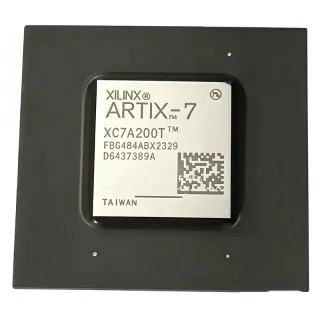
EPF10K200EFC672-2 - FLEX 10KE FPGA 200K Gates 672-BGA | Intel
MPN: EPF10K200EFC672-2 ✗ End of Life| Qty | Unit Price | Extended |
|---|---|---|
| 1 | $285 | $285.00 |
| 10 | $268 | $2,680.00 |
| 100 | $245 | $24,500.00 |
| 250 | $225 | $56,250.00 |
| 500 | $210 | $105,000.00 |
EPF10K200EFC672-2 Overview
A field programmable gate array (FPGA) is a semiconductor integrated circuit that can be reconfigured by the customer after manufacture to implement arbitrary digital logic. FPGAs occupy a unique position in the digital design hierarchy: more flexible than application-specific integrated circuits (ASICs) yet faster and more deterministic than microcontroller-based systems. The FLEX 10KE family combines a look-up-table (LUT)-based logic fabric with embedded array blocks (EABs) that can be configured as RAM, ROM, or FIFO, enabling block-level memory on-chip rather than relying solely on distributed flip-flops.
Key features include 470 user I/Os, an embedded array architecture that supports up to 98,304 bits of on-chip memory, JTAG-based in-system programmability via the IEEE 1149.1 boundary-scan interface, multi-volt I/O support, and CMOS process technology with low static power consumption. The 672-BGA package provides high-density interconnect for designs requiring extensive signal fan-out, with a 1.27 mm ball pitch and 45 x 45 mm body suitable for production surface-mount assembly.
Typical applications include telecommunications infrastructure, industrial control, glue-logic consolidation in legacy systems, digital signal processing front-ends, and prototyping platforms where migration to a structured ASIC is anticipated. The FLEX 10KE is widely deployed in designs originally prototyped in the late 1990s and remains in service today for industrial and military customers requiring long-life-cycle components.
When designing with this device, ensure that your synthesis toolchain supports the FLEX 10KE architecture (Altera/Intel Quartus legacy versions) and that PCB layout accommodates the 45 mm BGA footprint with adequate via-in-pad and microvia escape routing. Power supply sequencing and decoupling per the manufacturer datasheet are mandatory for reliable operation.
Drop-in alternatives for EPF10K200EFC672-2 — same package, pin-to-pin compatible. Different-package parts requiring PCB rework are excluded.
Variants in this series
Same-series models that are drop-in compatible with EPF10K200EFC672-2 (same form factor and footprint) — differing in Package, Operating Temperature, Process Technology, Family, Mounting Type.
Quick Comparison Tool — Select alternative parts for side-by-side comparison:
EPF10K200EFC672-3
✅ Drop-In✓ In Stock
$115 / Unit
View Datasheet →EPF10K200EFC672-1
✅ Drop-In✓ In Stock
$198 / Unit
View Datasheet →EPF10K200EFC672-2X
✅ Drop-In📋 Reference alternative (not in catalog)
EPF10K200EFC672-2N
✅ Drop-In📋 Reference alternative (not in catalog)
EPF10K130EFC672-2X
✅ Drop-In✓ In Stock
$92 / Unit
View Datasheet →EPF10K130EFC672-2
✅ Drop-In✓ In Stock
$61.75 / Unit
View Datasheet →EPF10K200EFC672-2 Maximum Ratings & Electrical Characteristics
| Family | FLEX 10KE |
| Logic Elements | 9,984 |
| Typical Gates | 200,000 |
| Maximum User I/Os | 470 |
| Embedded Memory | 98,304 bits |
| Embedded Array Blocks (EABs) | 12 |
| Logic Array Blocks (LABs) | 624 |
| Package | 672-BBGA (FineLine BGA) |
| Package Dimensions | 45 x 45 mm |
| Ball Pitch | 1.27 mm |
| Process Technology | 0.22 um CMOS |
| Speed Grade | -2 |
| Propagation Delay | 0.4 ns |
| Operating Temperature | 0 C to 70 C |
| Programmability | JTAG (IEEE 1149.1) / in-system |
| RoHS Status | Compliant (per distributor listing) |
| Logic Family | CMOS |
EPF10K200EFC672-2 45 x 45 mm Pin Configuration Guide
Pin configuration for EPF10K200EFC672-2 (45 x 45 mm package). This digital IC includes GPIO, communication interfaces (UART, SPI, I2C), and power pins. Refer to the manufacturer datasheet for alternate pin functions and configuration options. Essential for embedded system design and PCB layout.

No detailed pinout data available for EPF10K200EFC672-2.
Refer to the datasheet for full pin configuration.
Typical Applications
EPF10K200EFC672-2 is suitable for 6 applications: Telecommunications Infrastructure, Industrial Control and Automation, Digital Signal Processing Front-End, ASIC Prototyping and Logic Consolidation, Military and Aerospace Sustainment, Glue Logic Consolidation in Legacy Systems.
Telecommunications Infrastructure
The EPF10K200EFC672-2 fits telecommunications infrastructure applications because its 9,984 logic elements and 12 embedded array blocks (98,304 bits of block memory) support packet buffering, framing, and protocol adaptation functions common in legacy telecom line cards. The 470 user I/Os accommodate multi-standard backplane interfaces such as H.110, UTOPIA, and POS-PHY, while the 0.4 ns propagation delay and -2 speed grade deliver deterministic timing for cell and packet processing. The 672-BGA package enables compact line-card layouts where high I/O density is mandatory.
Recommended
Industrial Control and Automation
In industrial control applications the EPF10K200EFC672-2 consolidates discrete glue logic, motor-control sequencing, and fieldbus interface logic into a single reconfigurable device. Its embedded array blocks implement FIFO buffers for industrial protocols such as Profibus and CAN, while the 470 I/Os provide flexible interfacing to legacy 24V optically-isolated I/O modules. The commercial 0-70 C temperature range is suitable for cabinet-mounted industrial systems, and JTAG in-system programmability allows field firmware updates via standard boundary-scan tools without removing the part.
Recommended
Digital Signal Processing Front-End
The EPF10K200EFC672-2 is well suited as a DSP front-end co-processor because its 12 embedded array blocks implement multiplier coefficient tables, FIR filter tap memory, and FFT twiddle-factor ROMs without consuming distributed logic. The 98,304 embedded memory bits and 470 I/Os let designers build parallel data paths to external ADCs and DACs, while the 0.4 ns propagation delay handles high-sample-rate bit-stream processing. The FLEX 10KE architecture was a popular platform for implementing digital down-converters, channelizers, and baseband modem blocks in 1990s-era wireless infrastructure.
Recommended
ASIC Prototyping and Logic Consolidation
Design teams use the EPF10K200EFC672-2 to prototype ASICs because the 200K-gate capacity and 9,984 logic elements can absorb mid-complexity designs while preserving pin-for-pin migration to Altera HardCopy structured ASICs. The 672-BGA package mirrors HardCopy pinouts, so prototypes and production silicon share PCB layout, reducing engineering risk. The embedded array blocks act as on-chip ROM/RAM replacing mask-programmed memory, and JTAG programmability accelerates bring-up and design iteration.
Recommended
Military and Aerospace Sustainment
The EPF10K200EFC672-2 is widely deployed in long-life-cycle defense platforms where original FLEX 10KE designs must be sustained for 15-20+ years. Its mature 0.22 um CMOS process, stable Altera/Intel firmware toolchain (Quartus II legacy), and proven JTAG in-system reconfiguration make it suitable for avionics databuses, radar signal conditioning, and electronic-warfare subsystems where design re-validation costs are prohibitive. The 672-BGA package is ruggedized for vibration and thermal cycling per defense program requirements.
Recommended
Glue Logic Consolidation in Legacy Systems
The EPF10K200EFC672-2 excels at replacing multiple discrete PALs, GALs, and 74-series TTL packages in legacy backplane designs, reducing board area and improving reliability. With 9,984 logic elements the device can absorb dozens of legacy programmable-logic devices, and its 470 I/Os map directly to backplane connector pin counts on VME, PCI, and CompactPCI systems. The FLEX 10KE family was specifically designed for this register-and-decoder consolidation role in late-1990s computing and instrumentation platforms.
Recommended
Recommended Products Summary
Engineering reference data for EPF10K200EFC672-2 — comparison, design guidance, and compliance information.
Selection Guide
Comparison with Alternatives
| Parameter | This Product | EPF10K200EFC672-3 | EPF10K200EFC672-1 | EPF10K200EFC672-2X | EPF10K200EFC672-2N | EPF10K130EFC672-2 |
|---|---|---|---|---|---|---|
| Package | 672-FineLine BGA (45x45 mm, 1.27 mm pitch) | 672-FineLine BGA - same | 672-FineLine BGA - same | 672-FineLine BGA - same | 672-FineLine BGA - same | 672-FineLine BGA - same |
| Brand | Intel (formerly Altera) | Intel (formerly Altera) | Intel (formerly Altera) | Intel (formerly Altera) | Intel (formerly Altera) | Intel (formerly Altera) |
| Family | FLEX 10KE | FLEX 10KE - same | FLEX 10KE - same | FLEX 10KE - same | FLEX 10KE - same | FLEX 10KE - same |
| Logic Elements | 9,984 | 9,984 | 9,984 | 9,984 | 9,984 | 6,580 (-34%) |
| Typical Gates | 200,000 | 200,000 | 200,000 | 200,000 | 200,000 | 130,000 (-35%) |
| Speed Grade | -2 | -3 (faster) | -1 (slower) | -2 (extended) | -2 (lead-free) | -2 |
| Embedded Memory | 98,304 bits | 98,304 bits | 98,304 bits | 98,304 bits | 98,304 bits | 65,536 bits (-33%) |
| User I/Os | 470 | 470 | 470 | 470 | 470 | 376 (-20%) |
Key Differentiators
- Highest density FLEX 10KE in the 672-BGA package (vs EPF10K130EFC672-2)
- Balanced speed grade for general-purpose designs (vs EPF10K200EFC672-3)
- FineLine BGA package for high-I/O-density backplanes (vs EPF10K200EBC600-3)
Design Notes
The 672-FineLine BGA package dissipates up to approximately 2-3 W depending on toggle rate and utilization. The FLEX 10KE datasheet recommends a minimum 4-layer PCB with a continuous ground plane beneath the BGA to spread heat and provide low-impedance returns. For industrial applications above 70 C ambient or sustained high-utilization designs, attach a heatsink or use thermal vias to a copper heat-spreader layer.
The 672-BGA with 1.27 mm ball pitch requires microvia or via-in-pad technology for fan-out escape routing on at least the top two layers. Per the FLEX 10KE datasheet, all VCCINT and VCCIO pins must have local 0.1 uF decoupling capacitors placed within 5 mm of the ball, plus bulk 100 uF tantalum capacitors on each power rail at the board edge. JTAG TCK, TMS, TDI, TDO signals need 10 kohm pull-ups on TCK and TMS for stable boundary-scan operation.
Do not mix EPF10K200EFC672-2 with EPF10K200EBC600-3 on the same PCB layout - they share the FLEX 10KE logic but have different BGA ball counts (672 vs 600), so the footprints are incompatible. Configuration data must be loaded via Altera EPC series configuration PROM (e.g., EPC2LC20N for serial mode) - using the wrong PROM byte-order causes the device to fail configuration. Finally, the FLEX 10KE JTAG ID must be verified during board bring-up to confirm silicon revision matches the compiled Quartus object file.
Compliance Information
RoHS compliance per DigiKey product listing. AEC-Q100 not applicable - this is an FPGA, not an automotive-grade IC. Halogen-free and conflict-minerals status not stated in available data.